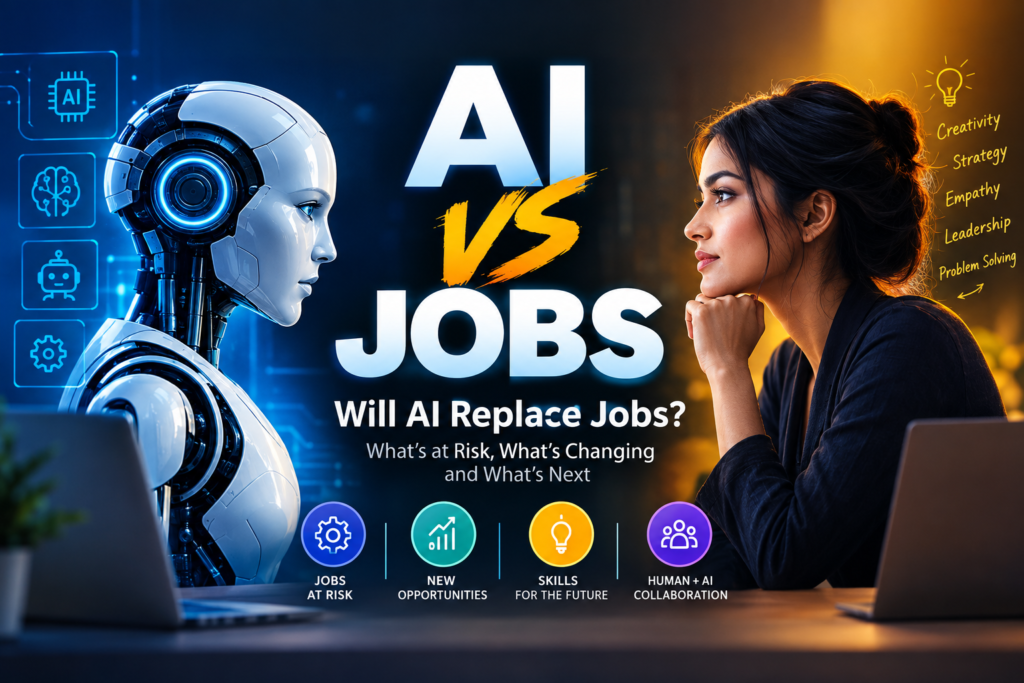
Artificial Intelligence (AI) has moved from being a futuristic concept to an everyday business tool. From writing content and designing graphics to analyzing data, answering customer queries, writing code, and automating repetitive tasks, AI is changing the way people work.
This has created one of the biggest questions of the modern workplace:
Will Artificial Intelligence Replace Human Workers?
The answer is more complicated than a simple yes or no. AI is likely to automate some tasks, transform many existing roles, and create entirely new types of work. The real challenge for workers and businesses is learning how to adapt.
What Is AI and Why Is It Changing Jobs?
Artificial Intelligence refers to technologies that enable computers and software to perform tasks that traditionally require human intelligence.
Will Artificial Intelligence Replace Human Workers?
Modern AI can:
- Understand and generate language
- Analyze large amounts of data
- Recognize images and patterns
- Generate images, videos, and audio
- Automate repetitive processes
- Assist with programming
- Predict trends and customer behavior
- Provide customer support
- Help businesses make data-driven decisions
The rapid development of generative AI has accelerated this transformation.
Tools powered by AI can now produce drafts, summarize documents, generate marketing ideas, create visuals, analyze information, and assist professionals with everyday tasks Will Artificial Intelligence Replace Human Workers?.
As a result, companies are reconsidering which tasks need humans, which can be automated, and where human judgment remains essential.
AI vs Jobs: What Is Actually Happening?
The debate is often presented as:
AI will take people’s jobs.
But the workplace transformation is more nuanced.
AI generally doesn’t replace an entire profession overnight. Instead, it often automates specific tasks within a job.
For example, a marketing professional may previously have spent hours researching keywords, creating initial ad copy, analyzing campaign data, and preparing reports.
AI can help automate parts of these activities.
But the marketer may still be responsible for:
- Understanding the client’s business
- Developing strategy
- Making creative decisions
- Managing budgets
- Understanding customers
- Reviewing AI-generated content
- Communicating with clients
- Making final decisions
This means the job can change without completely disappearing.
Jobs Most Likely to Be Affected by AI
Some occupations contain a large number of repetitive, predictable, or highly digital tasks Will Artificial Intelligence Replace Human Workers?. These roles may experience significant AI-driven transformation.
1. Data Entry
Data entry involves repetitive activities such as entering, organizing, and processing information.
AI-powered software can automate many of these processes, reducing the amount of manual work required.
2. Customer Support
AI chatbots and virtual assistants can answer common questions, provide basic troubleshooting, and handle routine customer requests.
Human agents can then focus on complicated or sensitive cases.
3. Content Production
AI can generate:
- Blog drafts
- Product descriptions
- Social media captions
- Email drafts
- Ad variations
- Basic reports
However, human editing, fact-checking, creativity, and brand understanding remain important.
4. Administrative Work
AI can help automate scheduling, document processing, meeting summaries, email organization, and other repetitive office tasks.
This could significantly change traditional administrative roles.
5. Basic Data Analysis
AI can process large datasets quickly and identify patterns that might take humans much longer to discover Will Artificial Intelligence Replace Human Workers?.
Professionals who learn to work with AI tools can potentially spend more time interpreting results and making strategic decisions.
Jobs That AI May Transform Rather Than Replace
Many jobs require a combination of technical knowledge, human communication, creativity, judgment, and responsibility.
These roles may be Will Artificial Intelligence Replace Human Workers?
For example:
Graphic Designers
AI can generate concepts and variations quickly, but designers still need to understand:
- Branding
- Visual hierarchy
- Typography
- User psychology
- Client requirements
- Creative direction
The designer’s role may shift from producing every individual asset manually toward directing, refining, and strategically using AI.
Digital Marketers
AI can help marketers with:
- Audience analysis
- Ad copy
- Campaign ideas
- Keyword research
- Reporting
- Data analysis
But successful marketing still requires understanding people, positioning brands, developing strategies, and making business decisions.
Software Developers
AI coding assistants can generate code and help developers identify bugs.
However, developers still need to understand architecture, security, requirements, testing, and system design.
Video Editors
AI can automate tasks such as transcription, captions, background removal, and certain editing processes.
Editors can therefore spend more time on storytelling, pacing, creative direction, and visual communication.
The Rise of AI-Augmented Jobs
One of the most important trends isn’t simply AI replacing humans.
Will Artificial Intelligence Replace Human Workers?
It is humans working with AI.
Imagine two employees:
Employee A: Doesn’t use AI and performs every repetitive task manually.
Employee B: Uses AI to automate repetitive tasks and spends more time on strategy, creativity, and decision-making.
The second employee may be able to accomplish significantly more in the same amount of time.
This creates a new workplace advantage:
The competition may increasingly be between people who use AI effectively and people who don’t.
AI Will Also Create New Jobs
Will Artificial Intelligence Replace Human Workers?
Technological revolutions don’t only eliminate certain tasks. They can also create new industries, services, and occupations.
AI is already creating demand for skills related to:
- AI implementation
- AI product development
- Machine learning
- Data science
- AI governance
- AI security
- AI training
- AI-assisted content production
- Automation consulting
- AI workflow development
- Human-AI interaction
Some job titles that are becoming increasingly relevant include AI engineer, AI product manager, AI consultant, AI governance specialist, automation specialist, and AI-focused data professional.
The exact job landscape will continue evolving as AI capabilities and business adoption develop.
Why Human Skills Still Matter
Will Artificial Intelligence Replace Human Workers?
AI can process information extremely quickly, but businesses don’t operate on information alone.
Human skills remain important.
Creativity
AI can generate many ideas, but humans still provide context, taste, cultural understanding, and creative direction.
Critical Thinking
AI-generated information needs to be evaluated.
People need to ask:
Is this accurate? Is it relevant? Is it ethical? Does it actually solve the problem?
Communication
Building relationships with customers, employees, clients, and partners requires human communication.
Leadership
Organizations still need people who can set goals, manage teams, resolve conflicts, and make difficult decisions.
Emotional Intelligence
Understanding emotions, trust, motivation, and interpersonal relationships remains an important human capability.
The Biggest Risk May Be Skill Obsolescence
Will Artificial Intelligence Replace Human Workers?
The AI revolution isn’t necessarily about every job disappearing.
A more immediate challenge is that the skills required for existing jobs can change quickly.
A professional who learned one set of tools five years ago may need to learn new technologies today.
This creates a growing importance for:
Continuous Learning
Professionals need to keep developing their skills rather than relying exclusively on what they learned earlier in their careers.
AI Literacy
People don’t necessarily need to become AI engineers.
But understanding how AI works, what it can do, its limitations, and how to use AI tools responsibly is becoming increasingly valuable.
Adaptability
The ability to learn new tools and workflows may become as important as expertise in a specific software platform.
AI vs Jobs: What Should Students Learn?
Will Artificial Intelligence Replace Human Workers?
Students entering the workforce face a particularly important question:
What skills will remain valuable in an AI-powered economy?
Instead of focusing only on one technical skill, students can consider building a combination of:
- Communication
- Problem-solving
- Creativity
- Analytical thinking
- Digital literacy
- AI literacy
- Domain expertise
- Collaboration
- Adaptability
The strongest career strategy may not be “learn something AI cannot do.”
Instead, it may be:
“Learn how to use AI while developing skills that complement it.”
What Businesses Should Do
Will Artificial Intelligence Replace Human Workers?
Businesses also have a major role in managing the transition.
Instead of treating AI purely as a cost-cutting technology, organizations can use it to improve productivity while investing in their employees.
Companies can:
- Identify repetitive tasks that can be automated.
- Train employees to use AI tools.
- Redesign workflows around human-AI collaboration.
- Maintain human oversight for important decisions.
- Establish clear AI policies.
- Protect customer and employee data.
- Regularly evaluate AI-generated outputs.
The goal doesn’t have to be “replace humans with AI.”
A more productive approach can be “use AI to help humans do better work.”
Will AI Take Your Job?
Will Artificial Intelligence Replace Human Workers?
This is probably the wrong question.
A better question is:
How will AI change your job?
A job that looks the same today may look very different a few years from now.
A marketer may become an AI-assisted strategist.
A designer may become a creative director working with generative tools.
A developer may become an AI-assisted software architect.
A customer service representative may handle fewer routine questions and more complex customer problems.
The technology can change the workflow without necessarily eliminating the underlying profession.
The Future of Work Will Be Human + AI
Will Artificial Intelligence Replace Human Workers?
The future workplace is unlikely to be completely human or completely automated.
Instead, we’re moving toward a hybrid model.
Humans bring:
- Creativity
- Judgment
- Empathy
- Strategy
- Leadership
- Context
- Accountability
AI brings:
- Speed
- Automation
- Pattern recognition
- Data processing
- Scalability
- Assistance
When these capabilities are combined effectively, organizations can potentially achieve higher productivity while allowing people to focus on more complex work.
Final Thoughts
Will Artificial Intelligence Replace Human Workers?
The AI vs Jobs debate is bigger than the question of whether machines will replace workers.
The more important issue is how work itself will evolve.
Some tasks will become automated. Some roles will change. New jobs will emerge. And many professionals will need to learn new skills.
AI isn’t simply creating a future without work. It is helping create a future where the nature of work is changing.
The people and organizations that continuously learn, adapt, and understand how to work alongside AI will be better positioned to navigate that transition.
The future may not be AI vs humans.
It may be humans with AI vs humans without AI.
How AI Will Change the Way We Work
Will Artificial Intelligence Replace Human Workers?
The question “Will AI replace jobs?” is becoming increasingly important for employees, business owners, students, and professionals across almost every industry. While artificial intelligence can automate many tasks, the future of employment is likely to involve a combination of automation, human expertise, and new types of work.
Rather than simply asking whether AI replacing jobs will become widespread, it is more useful to understand which parts of a job can be automated and which require human involvement.
AI Will Replace Tasks Before It Replaces Entire Jobs
Will Artificial Intelligence Replace Human Workers?
One of the biggest misconceptions about artificial intelligence is that it will immediately eliminate complete professions. In reality, AI is often more effective at replacing individual tasks.
For example, an accountant may use AI to organize financial data, identify unusual transactions, and prepare preliminary reports. However, the accountant may still need to interpret the information, communicate with clients, understand regulations, and make important professional decisions.
The same pattern can be seen in marketing, design, software development, customer service, healthcare, education, and many other industries.
This means that the future may not be about jobs replaced by AI, but about jobs that are redesigned around AI.
Which Jobs Could Be More Exposed to AI?
Will Artificial Intelligence Replace Human Workers?
Jobs involving highly repetitive and predictable digital tasks may experience greater automation.
Some examples include:
- Data entry
- Basic administrative processing
- Routine customer support
- Simple transcription
- Basic document processing
- Repetitive reporting
- Certain bookkeeping tasks
- Basic content production
- Routine scheduling
- Simple data analysis
This does not necessarily mean that everyone working in these occupations will lose their jobs. Instead, companies may use AI to handle routine activities while employees focus on tasks that require judgment, communication, creativity, and problem-solving.
What Jobs Are Harder for AI to Replace?
Will Artificial Intelligence Replace Human Workers?
Jobs that depend heavily on human interaction, physical environments, complex judgment, or interpersonal relationships can be more difficult to fully automate.
Examples include:
- Teachers
- Nurses
- Therapists
- Skilled tradespeople
- Managers
- Entrepreneurs
- Sales professionals
- Creative directors
- Social workers
- Consultants
- Leadership roles
Even when AI tools become useful in these professions, human involvement can remain an important part of the job.
For example, AI can help a teacher create lesson plans, but teaching also involves motivating students, understanding individual needs, managing classroom dynamics, and building relationships.
Will AI Replace Humans Completely?
Will Artificial Intelligence Replace Human Workers?
The question “Will AI replace humans completely?
?” has no simple answer.
AI systems can perform increasingly sophisticated tasks, but they operate within technological, organizational, legal, and practical constraints. They also depend on human-created data, instructions, infrastructure, and oversight Will AI replace humans completely ?.
There are many situations where businesses may prefer human involvement because customers value communication, accountability, trust, and personal interaction.
For example, a customer may be happy to use an AI chatbot to check an order status. However, when dealing with a complicated financial, medical, legal, or emotional situation, the need for human assistance can be much greater.
Therefore, Will AI replace humans completely? In some individual tasks, yes. In some specific roles, automation may substantially reduce the amount of human labor required. But replacing humans across the entire economy is a much broader and more complicated proposition.
AI May Create More Productive Employees
Will Artificial Intelligence Replace Human Workers?
One of the most important effects of AI could be increased productivity.
Imagine a digital marketer who previously spent several hours creating campaign reports. AI can help summarize data, identify patterns, and prepare an initial report.
The marketer can then spend more time developing strategy, communicating with clients, testing creative ideas, and improving campaigns.
Similarly, a graphic designer can use AI to explore multiple concepts quickly. A video editor can automate transcription and captioning. A software developer can use AI assistance for coding and debugging.
In each case, AI doesn’t necessarily eliminate the professional. Instead, it changes how that professional works.
New Jobs Could Emerge From AI
Will Artificial Intelligence Replace Human Workers?
Whenever technology changes an industry, new opportunities can emerge around that technology.
The growth of artificial intelligence is already creating demand for people with skills related to:
- AI development
- Machine learning
- Data analysis
- AI implementation
- Automation
- AI content workflows
- AI governance
- AI security
- AI product development
- AI consulting
There can also be new opportunities for professionals who combine AI skills with existing expertise.
For example, a digital marketer who understands AI automation may offer services that combine marketing strategy with automated workflows. A designer who understands generative AI may develop faster creative production systems.
This creates an important career opportunity: learning how to combine AI with an existing professional skill.
Why AI Skills Are Becoming Important
Will Artificial Intelligence Replace Human Workers?
Professionals don’t necessarily need to become AI engineers to benefit from artificial intelligence.
Basic AI literacy can be valuable across many industries.
Workers can learn:
- How to write effective prompts
- How to verify AI-generated information
- How to automate repetitive tasks
- How to use AI responsibly
- How to identify AI limitations
- How to integrate AI into existing workflows
The goal isn’t necessarily to let AI make every decision.
The goal is to understand where AI can save time and where human judgment should remain involved.
What Should Employees Do?
Will Artificial Intelligence Replace Human Workers?
If you’re worried about AI taking over jobs, one of the most practical responses is continuous learning.
Instead of focusing only on whether your current role will disappear, consider how your responsibilities might evolve.
Ask yourself:
Which parts of my work are repetitive?
Which tasks could AI automate?
Which skills require human judgment?
What AI tools are becoming relevant to my industry?
What new skills could make me more valuable?
Will Artificial Intelligence Replace Human Workers?
These questions can help professionals prepare for changes rather than simply react to them.
The Future May Be AI + Humans
Will Artificial Intelligence Replace Human Workers?
The future of work is unlikely to be a simple battle between humans and machines.
A more realistic scenario is collaboration.
AI can process information, automate repetitive work, generate ideas, and assist with analysis.
Humans can provide context, creativity, leadership, judgment, empathy, and accountability.
This combination could transform workplaces across industries.
The biggest change may therefore not be artificial intelligence taking over jobs, but artificial intelligence changing what people spend their working hours doing.
Final Perspective
So, will AI take over jobs?
AI will almost certainly automate some tasks, change existing roles, and create new forms of work. The exact scale and speed of these changes will vary by industry, occupation, technology, and business adoption.
Some jobs may shrink as automation increases.will Other jobs may evolve. New occupations may emerge around technologies that are difficult to predict today.
For workers, the most important response is adaptability.
Learning how to work with AI, developing strong human skills, and building expertise in a specific industry can help professionals navigate a rapidly changing employment landscape.
The future isn’t simply about will AI replacing humans completely.
It is about understanding how humans and AI can work together—and how the definition of a “job” itself may change in the years ahead.
AI may replace certain tasks. It may transform certain jobs. But the people who learn to use AI effectively can become an important part of the future workforce.
Pingback: The Future of Digital Marketing Agency: Trends, Technology, and Growth - shubhamworks