Ai

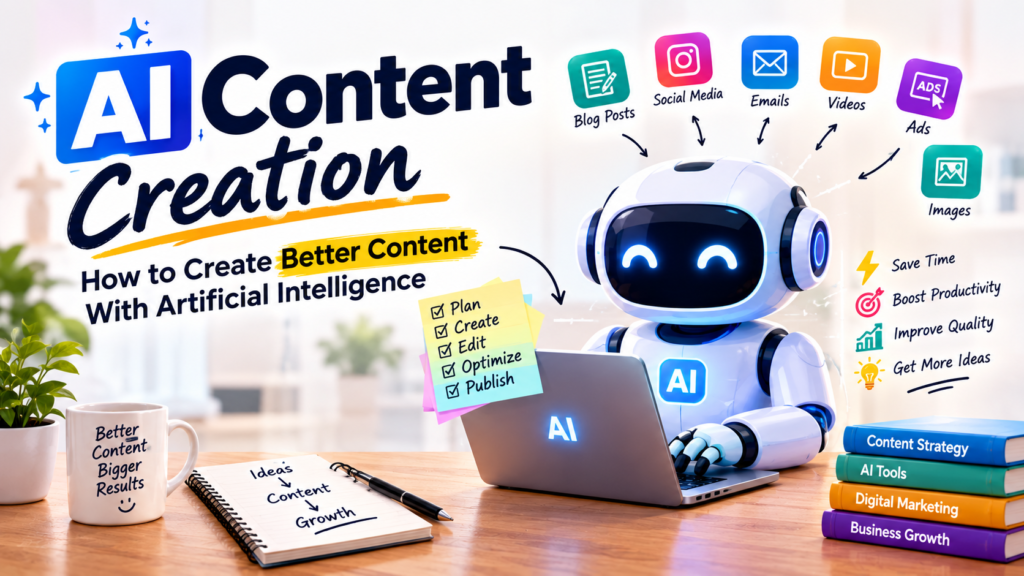
AI Content

AI Content Creation: How to Create Better Content With Artificial Intelligence

Content marketing has become one of the most important ways for businesses to attract audiences, build authority, and generate customers. But creating high-quality content consistently can take significant time and effort. Writers, marketers, designers, and business owners often need to research topics, create ideas, write drafts, edit content, optimize it for search engines, and distribute it across multiple platforms. This is where AI Content can change the workflow. AI-powered tools can help businesses brainstorm ideas, organize research, create first drafts, improve readability, generate variations, analyze patterns, and repurpose existing content. However, using artificial intelligence effectively does not mean publishing everything an AI tool produces without review. The real opportunity is to combine AI efficiency with human expertise, creativity, judgment, and brand knowledge. In this complete guide, we will explore how AI Content works, how businesses can use it, the benefits and limitations, practical workflows, SEO considerations, common mistakes, and strategies for creating useful content with artificial intelligence. What Is AI Content?   AI Content refers to text, images, video, audio, or other digital material created or assisted by artificial intelligence systems. Modern generative AI tools can analyze prompts and produce content based on patterns learned from large datasets. Depending on the tool, users can create blog drafts, social media captions, email copy, product descriptions, video scripts, advertisements, images, and more. The important distinction is between AI-assisted creation and completely automated publishing. AI Content can be most effective when humans remain involved in planning, fact-checking, editing, positioning, and quality control. Why Is AI Content Becoming Important? The demand for digital content continues to increase. Businesses need content for websites, search engines, social platforms, newsletters, advertisements, landing pages, and customer communication. Creating every asset manually can become difficult, especially for small teams. AI Content can reduce the time required for repetitive tasks and allow marketing teams to focus more attention on strategy and creative decisions. For example, a marketer can use AI to generate ten potential article angles, select the most useful idea, build an outline, research important questions, and then develop the final article using original insights and experience. This does not remove the human role. Instead, it changes where human effort is spent. How AI Content Creation Works A typical workflow begins with a prompt. The user provides information about the topic, audience, objective, tone, format, and constraints. The AI system then generates an output based on those instructions. A better workflow includes several stages: Define the objective Research the audience Create a content brief Generate ideas Build an outline Draft the content Verify facts Add original insights Edit and improve Optimize for the platform Publish and measure This process makes AI Content more useful because the technology supports a broader strategy instead of replacing it. AI Content for Blog Writing Blogging is one of the most common applications of generative AI. AI tools can help with topic ideation, outlines, introductions, FAQs, headings, examples, summaries, and content repurposing. However, a strong blog still needs a clear purpose. Before generating an article, identify: Target audience Search intent Primary keyword Secondary topics Business objective Unique perspective Desired action AI Content becomes more valuable when the brief is specific. For example, instead of asking an AI tool to “write a blog about digital marketing,” a marketer can provide the target audience, search intent, business context, article structure, tone, and specific questions that should be answered. Using AI for Content Research Research can take a large amount of time. AI tools can help organize information, summarize material provided by the user, identify questions, compare concepts, and generate research directions. However, important facts should be checked against reliable sources. AI systems can sometimes produce incorrect or outdated information. This is particularly important for statistics, laws, product specifications, medical topics, financial information, and rapidly changing technologies. AI Content should therefore be treated as a starting point for research rather than an automatic guarantee of accuracy. AI Content and SEO Search engine optimization is another area where AI can support content teams. AI can help identify related topics, organize keyword clusters, generate title ideas, improve headings, create FAQs, and identify content gaps. But SEO is not simply about inserting keywords into an article. Search engines aim to provide useful results that satisfy user intent. High-quality AI Content should therefore focus on usefulness, clarity, relevance, originality, and a strong user experience. A business should avoid producing large amounts of generic content simply because AI makes production faster. Using AI for Social Media Content Social media requires a constant flow of ideas. AI can help generate: Caption ideas Hooks Short-form video scripts Carousel structures Content calendars Poll questions Engagement prompts Hashtag ideas Platform-specific variations For example, one long blog article can become a LinkedIn post, Instagram carousel, short video script, email newsletter, and several social media posts. This process is called content repurposing. AI Content makes repurposing faster because the same core idea can be adapted into multiple formats. AI Content for Email Marketing Email campaigns often require multiple versions of subject lines, introductions, offers, and calls to action. AI can help marketers generate variations quickly. For example, a single campaign could have different messaging for: New subscribers Existing customers High-intent leads Previous customers Inactive subscribers Personalization should still be based on legitimate customer information and appropriate marketing practices. The goal is to make communication more relevant, not simply to automate every message. AI Content for Advertising Paid advertising requires continuous testing. Marketers often need multiple headlines, descriptions, hooks, calls to action, and creative concepts. AI can help generate variations that can then be reviewed and tested. Instead of asking AI to decide which advertisement will definitely perform best, marketers can use it to create a larger testing pool. Actual campaign data should determine what works. AI Content can therefore support the creative testing process without replacing performance analysis. AI Content for Video Marketing Video has become a major content format across platforms. AI can support video production through: Script ideas Storyboards Video hooks Scene descriptions Captions Transcription

AI Content Creation: How to Create Better Content With Artificial Intelligence Read More »
Ai in Digital Marketing

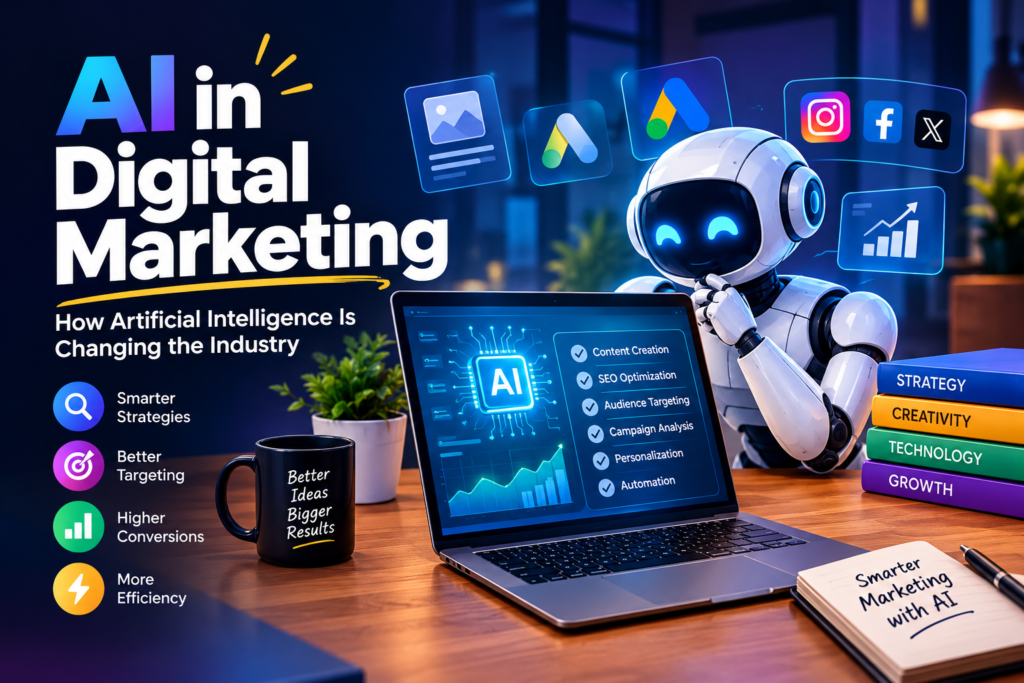
AI in Digital Marketing: How Artificial Intelligence Is Changing the Industry

Artificial intelligence is no longer limited to research labs or advanced technology companies. It is becoming an important part of how businesses understand customers, create content, automate repetitive work, optimize advertising, and improve online experiences. Ai in Digital Marketing is helping marketers move from manual decision-making toward faster, data-driven, and increasingly personalized strategies. For businesses of every size, Ai in Digital Marketing can support activities ranging from customer research and content planning to paid advertising, search optimization, email marketing, analytics, and customer service. The goal is not simply to replace human marketers. Instead, the strongest approach combines artificial intelligence with human creativity, strategy, judgment, and brand understanding. In this guide, we will explore what Ai in Digital Marketing means, how it works, its major applications, benefits, limitations, practical use cases, and the future of AI-powered marketing. What Is Ai in Digital Marketing? Understanding Ai in Digital Marketing starts with recognizing that AI is a marketing capability, not a single software product. Ai in Digital Marketing refers to the use of artificial intelligence technologies to analyze information, identify patterns, automate marketing tasks, generate or assist with content, predict customer behavior, and improve marketing decisions. Traditional digital marketing often requires marketers to manually collect data, analyze campaigns, create variations, segment audiences, and optimize activities. AI can process large amounts of information much faster and help marketers identify patterns that may be difficult to discover manually. Examples include AI-assisted content creation, predictive analytics, recommendation systems, conversational chatbots, automated audience segmentation, campaign optimization, sentiment analysis, and personalized customer experiences. Ai in Digital Marketing does not mean that every marketing activity needs to be fully automated. In many cases, AI works best as a decision-support and productivity layer that helps people work faster and make better-informed decisions. Why Is AI Becoming Important in Marketing? The digital marketing environment has become increasingly complex. Customers interact with brands across search engines, websites, social networks, video platforms, email, messaging applications, and other digital channels. Marketers therefore have to manage large amounts of data and create relevant experiences across multiple touchpoints. Ai in Digital Marketing can help organize this complexity by processing data, identifying patterns, and automating repetitive workflows. Another reason for its growth is the increasing expectation for personalization. Customers often expect brands to understand their interests and provide useful information at the right time. AI can help marketers create different experiences for different audience segments without manually building every variation. At the same time, AI tools are becoming easier to access. Small businesses, agencies, freelancers, and large organizations can use AI-powered software for research, writing assistance, analytics, customer support, and campaign management. For agencies, Ai in Digital Marketing can connect research, campaign execution, reporting, and optimization into a more efficient workflow. How Ai in Digital Marketing Is Changing the Industry The biggest change is not one single tool. It is the way marketers approach planning, execution, optimization, and measurement. Ai in Digital Marketing is changing the industry in several important areas. 1. AI-Powered Customer Research Ai in Digital Marketing can help marketers analyze customer feedback, reviews, survey responses, search behavior, support conversations, and other available data to identify common themes. Understanding the target audience is one of the foundations of effective marketing. AI can analyze large amounts of customer information and identify common questions, pain points, preferences, objections, and buying motivations. For example, an ecommerce company can analyze thousands of customer reviews to identify frequently mentioned product benefits and complaints. Those findings can then influence landing pages, ad messaging, product descriptions, and content strategy. 2. Smarter Content Creation Content marketing requires a constant flow of ideas, research, drafts, visuals, and distribution plans. Ai in Digital Marketing can accelerate many parts of this process. AI tools can assist with brainstorming blog topics, creating outlines, generating first drafts, improving headlines, summarizing information, developing social media ideas, and adapting content for different channels. However, human review remains important. AI-generated content can contain inaccurate information, repetitive language, generic ideas, or a tone that does not match the brand. The most effective workflow is usually AI-assisted rather than completely AI-controlled: use AI for speed, then use human expertise for accuracy, originality, strategy, and brand voice. 3. Personalized Marketing Personalization has become an important part of customer experience. Instead of showing the same message to everyone, brands can use data to create more relevant experiences. Ai in Digital Marketing can help marketers segment audiences according to behavior, interests, purchase history, engagement, and other signals. For example, an online store could show different product recommendations to a first-time visitor and a returning customer. An email campaign could also adapt its messaging according to previous interactions. When implemented responsibly, personalization can make marketing communication more relevant and useful. 4. Better Advertising Optimization Paid advertising involves constant monitoring and optimization. Marketers need to evaluate audiences, creatives, keywords, bids, placements, conversion rates, and other performance signals. Ai in Digital Marketing can support this process by analyzing campaign data and identifying patterns that can inform optimization. Advertising platforms already use machine learning in areas such as bidding, audience delivery, creative combinations, and conversion optimization. Marketers still need to define goals, provide suitable inputs, monitor performance, and make strategic decisions. AI can therefore reduce some manual work while allowing marketers to focus more on campaign strategy and business objectives. Another major application of Ai in Digital Marketing is creative testing, where marketers can develop and compare multiple concepts more efficiently. 5. Predictive Analytics Traditional analytics often tells marketers what happened. Predictive analytics attempts to estimate what could happen next based on available data and patterns. Ai in Digital Marketing can help businesses identify customers who may be more likely to purchase, churn, engage, or respond to a particular offer. For example, a subscription business could analyze customer behavior to identify patterns associated with cancellation. The marketing team could then create targeted retention campaigns. Predictions are not guarantees. Their usefulness depends on the quality of data, model design, business context, and ongoing validation. 6. AI Chatbots and Customer Support

AI in Digital Marketing: How Artificial Intelligence Is Changing the Industry Read More »

Will Artificial Intelligence Replace Human Workers? ai

Will Artificial Intelligence Replace Humans 2026?

Artificial Intelligence (AI) has moved from being a futuristic concept to an everyday business tool. From writing content and designing graphics to analyzing data, answering customer queries, writing code, and automating repetitive tasks, AI is changing the way people work. This has created one of the biggest questions of the modern workplace: Will Artificial Intelligence Replace Human Workers? The answer is more complicated than a simple yes or no. AI is likely to automate some tasks, transform many existing roles, and create entirely new types of work. The real challenge for workers and businesses is learning how to adapt. What Is AI and Why Is It Changing Jobs? Artificial Intelligence refers to technologies that enable computers and software to perform tasks that traditionally require human intelligence. Will Artificial Intelligence Replace Human Workers? Modern AI can: Understand and generate language Analyze large amounts of data Recognize images and patterns Generate images, videos, and audio Automate repetitive processes Assist with programming Predict trends and customer behavior Provide customer support Help businesses make data-driven decisions The rapid development of generative AI has accelerated this transformation. Tools powered by AI can now produce drafts, summarize documents, generate marketing ideas, create visuals, analyze information, and assist professionals with everyday tasks Will Artificial Intelligence Replace Human Workers?. As a result, companies are reconsidering which tasks need humans, which can be automated, and where human judgment remains essential. AI vs Jobs: What Is Actually Happening? The debate is often presented as: AI will take people’s jobs. But the workplace transformation is more nuanced. AI generally doesn’t replace an entire profession overnight. Instead, it often automates specific tasks within a job. For example, a marketing professional may previously have spent hours researching keywords, creating initial ad copy, analyzing campaign data, and preparing reports. AI can help automate parts of these activities. But the marketer may still be responsible for: Understanding the client’s business Developing strategy Making creative decisions Managing budgets Understanding customers Reviewing AI-generated content Communicating with clients Making final decisions This means the job can change without completely disappearing. Jobs Most Likely to Be Affected by AI Some occupations contain a large number of repetitive, predictable, or highly digital tasks Will Artificial Intelligence Replace Human Workers?. These roles may experience significant AI-driven transformation. 1. Data Entry Data entry involves repetitive activities such as entering, organizing, and processing information. AI-powered software can automate many of these processes, reducing the amount of manual work required. 2. Customer Support AI chatbots and virtual assistants can answer common questions, provide basic troubleshooting, and handle routine customer requests. Human agents can then focus on complicated or sensitive cases. 3. Content Production AI can generate: Blog drafts Product descriptions Social media captions Email drafts Ad variations Basic reports However, human editing, fact-checking, creativity, and brand understanding remain important. 4. Administrative Work AI can help automate scheduling, document processing, meeting summaries, email organization, and other repetitive office tasks. This could significantly change traditional administrative roles. 5. Basic Data Analysis AI can process large datasets quickly and identify patterns that might take humans much longer to discover Will Artificial Intelligence Replace Human Workers?. Professionals who learn to work with AI tools can potentially spend more time interpreting results and making strategic decisions. Jobs That AI May Transform Rather Than Replace Many jobs require a combination of technical knowledge, human communication, creativity, judgment, and responsibility. These roles may be Will Artificial Intelligence Replace Human Workers? For example: Graphic Designers AI can generate concepts and variations quickly, but designers still need to understand: Branding Visual hierarchy Typography User psychology Client requirements Creative direction The designer’s role may shift from producing every individual asset manually toward directing, refining, and strategically using AI. Digital Marketers AI can help marketers with: Audience analysis Ad copy Campaign ideas Keyword research Reporting Data analysis But successful marketing still requires understanding people, positioning brands, developing strategies, and making business decisions. Software Developers AI coding assistants can generate code and help developers identify bugs. However, developers still need to understand architecture, security, requirements, testing, and system design. Video Editors AI can automate tasks such as transcription, captions, background removal, and certain editing processes. Editors can therefore spend more time on storytelling, pacing, creative direction, and visual communication. The Rise of AI-Augmented Jobs One of the most important trends isn’t simply AI replacing humans. Will Artificial Intelligence Replace Human Workers? It is humans working with AI. Imagine two employees: Employee A: Doesn’t use AI and performs every repetitive task manually. Employee B: Uses AI to automate repetitive tasks and spends more time on strategy, creativity, and decision-making. The second employee may be able to accomplish significantly more in the same amount of time. This creates a new workplace advantage: The competition may increasingly be between people who use AI effectively and people who don’t. AI Will Also Create New Jobs Will Artificial Intelligence Replace Human Workers? Technological revolutions don’t only eliminate certain tasks. They can also create new industries, services, and occupations. AI is already creating demand for skills related to: AI implementation AI product development Machine learning Data science AI governance AI security AI training AI-assisted content production Automation consulting AI workflow development Human-AI interaction Some job titles that are becoming increasingly relevant include AI engineer, AI product manager, AI consultant, AI governance specialist, automation specialist, and AI-focused data professional. The exact job landscape will continue evolving as AI capabilities and business adoption develop. Why Human Skills Still Matter Will Artificial Intelligence Replace Human Workers? AI can process information extremely quickly, but businesses don’t operate on information alone. Human skills remain important. Creativity AI can generate many ideas, but humans still provide context, taste, cultural understanding, and creative direction. Critical Thinking AI-generated information needs to be evaluated. People need to ask: Is this accurate? Is it relevant? Is it ethical? Does it actually solve the problem? Communication Building relationships with customers, employees, clients, and partners requires human communication. Leadership Organizations still need people who can set goals, manage teams, resolve conflicts, and make

Will Artificial Intelligence Replace Humans 2026? Read More »