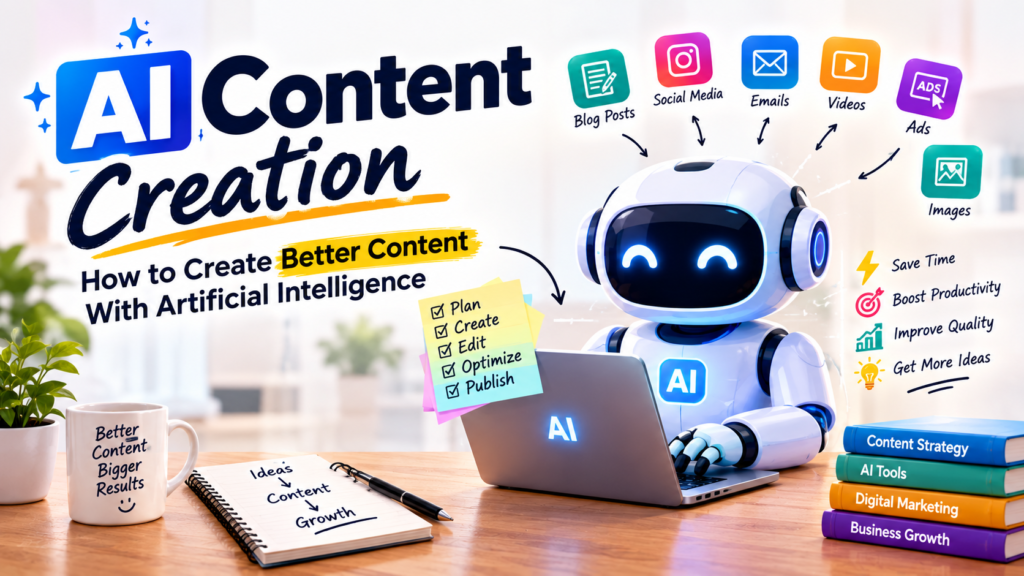
Content marketing has become one of the most important ways for businesses to attract audiences, build authority, and generate customers. But creating high-quality content consistently can take significant time and effort. Writers, marketers, designers, and business owners often need to research topics, create ideas, write drafts, edit content, optimize it for search engines, and distribute it across multiple platforms.
This is where AI Content can change the workflow.
AI-powered tools can help businesses brainstorm ideas, organize research, create first drafts, improve readability, generate variations, analyze patterns, and repurpose existing content. However, using artificial intelligence effectively does not mean publishing everything an AI tool produces without review.
The real opportunity is to combine AI efficiency with human expertise, creativity, judgment, and brand knowledge.
In this complete guide, we will explore how AI Content works, how businesses can use it, the benefits and limitations, practical workflows, SEO considerations, common mistakes, and strategies for creating useful content with artificial intelligence.
What Is AI Content?
AI Content refers to text, images, video, audio, or other digital material created or assisted by artificial intelligence systems.
Modern generative AI tools can analyze prompts and produce content based on patterns learned from large datasets. Depending on the tool, users can create blog drafts, social media captions, email copy, product descriptions, video scripts, advertisements, images, and more.
The important distinction is between AI-assisted creation and completely automated publishing.
AI Content can be most effective when humans remain involved in planning, fact-checking, editing, positioning, and quality control.
Why Is AI Content Becoming Important?
The demand for digital content continues to increase. Businesses need content for websites, search engines, social platforms, newsletters, advertisements, landing pages, and customer communication.
Creating every asset manually can become difficult, especially for small teams.
AI Content can reduce the time required for repetitive tasks and allow marketing teams to focus more attention on strategy and creative decisions.
For example, a marketer can use AI to generate ten potential article angles, select the most useful idea, build an outline, research important questions, and then develop the final article using original insights and experience.
This does not remove the human role. Instead, it changes where human effort is spent.
How AI Content Creation Works
A typical workflow begins with a prompt.
The user provides information about the topic, audience, objective, tone, format, and constraints. The AI system then generates an output based on those instructions.
A better workflow includes several stages:
- Define the objective
- Research the audience
- Create a content brief
- Generate ideas
- Build an outline
- Draft the content
- Verify facts
- Add original insights
- Edit and improve
- Optimize for the platform
- Publish and measure
This process makes AI Content more useful because the technology supports a broader strategy instead of replacing it.
AI Content for Blog Writing
Blogging is one of the most common applications of generative AI.
AI tools can help with topic ideation, outlines, introductions, FAQs, headings, examples, summaries, and content repurposing.
However, a strong blog still needs a clear purpose.
Before generating an article, identify:
- Target audience
- Search intent
- Primary keyword
- Secondary topics
- Business objective
- Unique perspective
- Desired action
AI Content becomes more valuable when the brief is specific.
For example, instead of asking an AI tool to “write a blog about digital marketing,” a marketer can provide the target audience, search intent, business context, article structure, tone, and specific questions that should be answered.
Using AI for Content Research
Research can take a large amount of time.
AI tools can help organize information, summarize material provided by the user, identify questions, compare concepts, and generate research directions.
However, important facts should be checked against reliable sources.
AI systems can sometimes produce incorrect or outdated information. This is particularly important for statistics, laws, product specifications, medical topics, financial information, and rapidly changing technologies.
AI Content should therefore be treated as a starting point for research rather than an automatic guarantee of accuracy.
AI Content and SEO
Search engine optimization is another area where AI can support content teams.
AI can help identify related topics, organize keyword clusters, generate title ideas, improve headings, create FAQs, and identify content gaps.
But SEO is not simply about inserting keywords into an article.
Search engines aim to provide useful results that satisfy user intent.
High-quality AI Content should therefore focus on usefulness, clarity, relevance, originality, and a strong user experience.
A business should avoid producing large amounts of generic content simply because AI makes production faster.
Using AI for Social Media Content
Social media requires a constant flow of ideas.
AI can help generate:
- Caption ideas
- Hooks
- Short-form video scripts
- Carousel structures
- Content calendars
- Poll questions
- Engagement prompts
- Hashtag ideas
- Platform-specific variations
For example, one long blog article can become a LinkedIn post, Instagram carousel, short video script, email newsletter, and several social media posts.
This process is called content repurposing.
AI Content makes repurposing faster because the same core idea can be adapted into multiple formats.
AI Content for Email Marketing
Email campaigns often require multiple versions of subject lines, introductions, offers, and calls to action.
AI can help marketers generate variations quickly.
For example, a single campaign could have different messaging for:
- New subscribers
- Existing customers
- High-intent leads
- Previous customers
- Inactive subscribers
Personalization should still be based on legitimate customer information and appropriate marketing practices.
The goal is to make communication more relevant, not simply to automate every message.
AI Content for Advertising
Paid advertising requires continuous testing.
Marketers often need multiple headlines, descriptions, hooks, calls to action, and creative concepts.
AI can help generate variations that can then be reviewed and tested.
Instead of asking AI to decide which advertisement will definitely perform best, marketers can use it to create a larger testing pool.
Actual campaign data should determine what works.
AI Content can therefore support the creative testing process without replacing performance analysis.
AI Content for Video Marketing
Video has become a major content format across platforms.
AI can support video production through:
- Script ideas
- Storyboards
- Video hooks
- Scene descriptions
- Captions
- Transcription
- Summaries
- Repurposing
For example, a 10-minute educational video can be converted into short clips, a blog post, social captions, and an email.
This creates a more efficient content ecosystem.
AI Content for Ecommerce
Ecommerce businesses often manage hundreds or thousands of product pages.
AI can help create initial product descriptions, feature summaries, category copy, FAQs, and promotional variations.
However, product information should always be checked against actual specifications.
A product description should accurately represent what the customer will receive.
AI Content can help scale ecommerce copy, but accuracy remains essential.
Benefits of AI Content Creation
One major benefit is speed.
AI can generate a first draft much faster than starting from a blank page.
Another benefit is idea generation. When marketers run out of topics, AI can provide alternative angles and questions.
Consistency is another advantage. Teams can create style guidelines and use them to produce content with a more consistent structure.
AI can also help with personalization and repurposing.
For small businesses, these benefits can be particularly useful because a small team can produce more marketing assets without increasing every manual task.
The Limitations of AI Content
AI is not perfect.
One of the biggest limitations is factual accuracy. AI can sometimes generate information that sounds convincing but is incorrect.
Another issue is originality.
If thousands of businesses use similar prompts and publish similar outputs, their content can become repetitive.
AI can also struggle with personal experience, nuanced brand voice, cultural context, and genuinely original insights.
This is why human review remains important when creating AI Content.
Human Creativity vs AI
AI is powerful at processing patterns and generating variations, but human creators bring experiences, opinions, emotions, relationships, and contextual understanding.
A marketer may understand a customer’s frustration because they have spoken with dozens of customers.
A designer may understand why a visual feels appropriate for a specific brand.
A business owner may know an industry story that cannot be generated from generic information.
The strongest approach is collaboration.
AI can accelerate the production process while humans provide direction and meaning.
How to Create Better AI Content
Creating better AI Content starts with better inputs.
Instead of using short, vague prompts, provide context.
Include:
- Audience
- Goal
- Topic
- Tone
- Format
- Length
- Key points
- Brand information
- Examples
- Restrictions
- Desired call to action
The more useful context the system receives, the more relevant the output can become.
Create a Strong Brand Voice
Every business should have a recognizable communication style.
Define whether your brand should sound:
- Professional
- Friendly
- Premium
- Educational
- Conversational
- Bold
- Technical
- Simple
AI Content should be edited to match this voice.
A generic AI tone can make a brand sound like every other company online.
Add Original Expertise
One of the easiest ways to improve AI-generated content is to add information that comes from real experience.
Include:
- Customer questions
- Internal data
- Case studies
- Examples
- Expert opinions
- Lessons learned
- Original research
- Industry observations
This makes AI Content more useful and differentiated.
Fact-Check AI Content
Never assume that every AI-generated statement is correct.
Check statistics, names, dates, research findings, quotes, technical claims, and other important details.
For business content, inaccurate information can damage credibility.
Fact-checking is especially important when content affects purchasing decisions.
AI Content and Google’s Search Results
Businesses often ask whether AI-generated content can rank in search engines.
The important consideration is not simply whether AI was used.
Content should provide value to users, demonstrate appropriate expertise, and satisfy the purpose of the search.
Publishing large amounts of low-quality content simply because it can be produced cheaply is unlikely to create a sustainable content strategy.
A better approach is to use AI as a production assistant while maintaining strong editorial standards.
Common AI Content Mistakes
One common mistake is publishing AI output without editing.
Another is creating content without understanding the audience.
Other problems include:
- Repetitive writing
- Generic examples
- Unverified facts
- Weak brand voice
- Keyword stuffing
- Lack of original insight
- Poor formatting
- Over-automation
- Ignoring user intent
Avoiding these mistakes can significantly improve the quality of AI Content.
A Practical AI Content Workflow
A practical workflow can look like this:
Step 1: Research the Audience
Understand the questions and problems your audience has.
Step 2: Select a Topic
Choose a topic that supports both audience needs and business objectives.
Step 3: Create a Brief
Define the keyword, intent, format, angle, and required sections.
Step 4: Generate Ideas
Use AI to brainstorm different approaches.
Step 5: Build an Outline
Create a logical structure before drafting.
Step 6: Generate a Draft
Use AI to accelerate the initial writing process.
Step 7: Add Human Expertise
Include original examples, experiences, data, and opinions.
Step 8: Fact-Check
Verify important information.
Step 9: Edit
Improve clarity, tone, flow, and readability.
Step 10: Optimize
Adapt the content for SEO, social media, email, or another platform.
Step 11: Publish and Measure
Track engagement and business outcomes.
This workflow turns AI Content into a repeatable marketing process.
Measuring Content Performance
Creating content is only one part of content marketing.
Businesses should measure results.
Useful metrics include:
- Organic traffic
- Engagement
- Time on page
- Leads
- Conversion rate
- Email clicks
- Social interactions
- Video retention
- Revenue
- Customer acquisition cost
The most important metrics depend on the content objective.
An awareness article may focus on reach and organic traffic, while a product page may focus more heavily on conversions.
AI Content for Different Business Types
Different businesses can use AI Content in different ways depending on their goals.
A digital marketing agency can use AI Content to develop educational articles, campaign concepts, social media calendars, email sequences, and client reports. The agency can then add campaign data and strategic insights to make the material more useful.
A local business can use AI Content to create service descriptions, frequently asked questions, location-based topics, promotional posts, and customer education material.
A SaaS company can use AI Content for product documentation, onboarding emails, comparison pages, feature explanations, and educational resources.
An ecommerce brand can use AI Content to scale product-related copy while keeping product specifications accurate and consistent.
The important point is that the technology should support the business objective rather than become the objective itself.
AI Content and Content Personalization
Personalization can make marketing communication more relevant.
Instead of sending identical messages to every person, businesses can create different versions for different audiences.
For example, a software company may communicate differently with a startup founder, an enterprise manager, and a freelancer.
This technology can help create these variations quickly, but the underlying audience segmentation should come from a clear marketing strategy.
Personalization should also avoid making customers uncomfortable. Businesses should use customer information responsibly and be transparent about how data is used.
AI Content Quality Checklist
Before publishing any AI-assisted asset, marketers can use a simple checklist.
Ask:
- Does the content answer the user’s actual question?
- Is every important fact accurate?
- Does it contain original information?
- Does it sound like our brand?
- Is the structure easy to read?
- Does it match the search or platform intent?
- Does it contain unnecessary repetition?
- Is the call to action relevant?
- Has a human reviewed it?
This checklist helps prevent low-quality AI Content from reaching customers.
How Agencies Can Use AI Content More Effectively
Marketing agencies often manage several clients and multiple content formats.
AI can help agencies organize production, but quality control becomes even more important when working across different brands.
Each client should have a separate content brief containing brand voice, audience information, positioning, prohibited claims, preferred terminology, and content goals.
AI Content can then be generated within those boundaries.
An agency should also maintain a human approval process before publishing important client-facing material.
This creates a balance between production speed and professional standards.
AI Content and Content Repurposing
One of the strongest practical applications is turning one high-quality asset into multiple smaller assets.
Imagine a business publishes one detailed guide.
That guide can become:
- Five social posts
- Three short video scripts
- One newsletter
- One carousel
- Several FAQs
- A podcast outline
- Multiple discussion topics
It can accelerate this transformation while allowing the original idea to remain consistent across channels.
This is particularly useful for small marketing teams that need to maintain an active presence on multiple platforms.
Building a Sustainable AI Content Strategy
A sustainable strategy should begin with quality rather than volume.
Create a clear content calendar based on audience needs, business priorities, and search opportunities.
Then decide where AI can help and where human involvement is essential.
For example, AI may handle brainstorming and first drafts, while experienced marketers handle positioning, fact-checking, editing, and final approval.
Over time, businesses can analyze which content formats generate traffic, engagement, leads, and sales.
Those insights can then improve future content planning.
In this way, AI Content becomes part of a broader marketing system instead of a shortcut for publishing large quantities of material.
Future of AI Content Creation
AI content tools will continue becoming more capable.
We can expect stronger personalization, better multimodal generation, improved automation, and deeper integration with marketing platforms.
AI may increasingly help businesses transform one idea into many formats automatically.
For example, a single campaign concept could generate a blog outline, social posts, email copy, video scripts, ad variations, and visual concepts.
However, the value of human strategy is unlikely to disappear.
As content production becomes easier, originality, credibility, expertise, and strong positioning may become even more important.
Final Thoughts
AI Content is changing the way businesses approach content creation.
It can help marketers save time, generate ideas, repurpose information, create variations, and manage large content workflows.
But artificial intelligence should not be treated as a replacement for strategy or human creativity.
The strongest results come from combining technology with human judgment.
Use AI to overcome the blank page. Use it to explore ideas. Use it to speed up repetitive tasks. Use it to repurpose valuable information.
Then add the elements that make content genuinely useful: experience, expertise, accuracy, originality, personality, and a clear understanding of the audience.
The future of content marketing will not simply belong to businesses that produce the most content.
It will belong to businesses that produce useful content efficiently while maintaining quality and trust.
When used thoughtfully, AI Content can become a powerful part of a modern content marketing system — helping businesses create more, learn faster, and communicate with their audiences more effectively.
Final Takeaway
The biggest advantage of AI Content is not simply that it can write faster.
Its real value is that it can help teams move from idea to execution more efficiently.
When combined with strong strategy, reliable research, human creativity, and careful editing, AI can support a content operation that is faster without sacrificing usefulness.
Businesses should therefore focus on building a process where artificial intelligence handles appropriate repetitive tasks and people remain responsible for decisions that require context, judgment, and originality.
That balance can help brands create content that is efficient, useful, recognizable, and aligned with real customer needs.