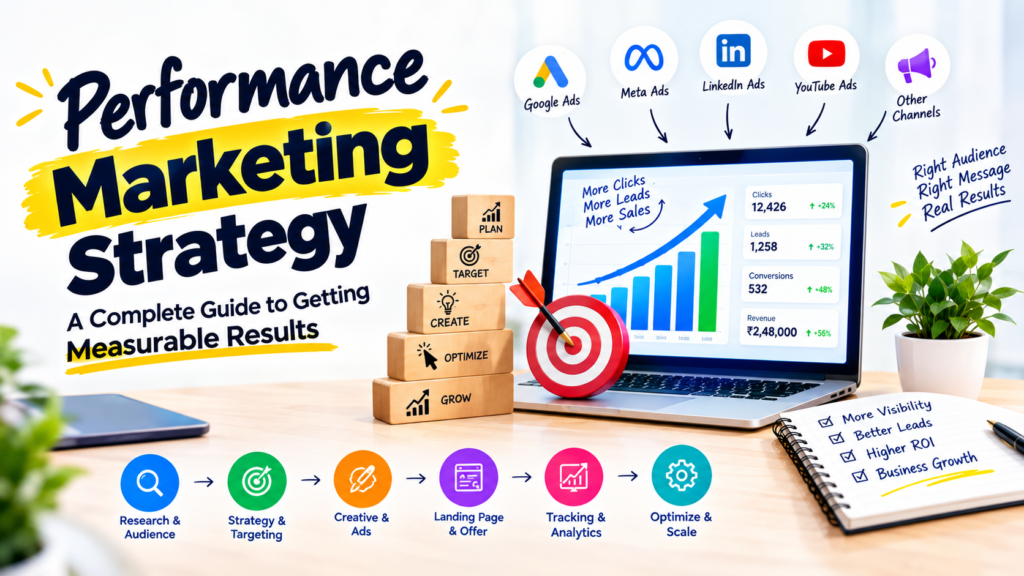
A Performance Marketing Strategy helps businesses focus on measurable marketing outcomes instead of simply spending money on advertising and hoping for results.
Unlike traditional marketing approaches where measuring the direct impact of every campaign can be difficult, performance-focused campaigns are built around measurable actions such as clicks, leads, registrations, purchases, bookings, or revenue.
A successful Performance Marketing Strategy connects advertising, audience targeting, creative content, landing pages, conversion tracking, and optimization into one complete system.
The goal is not simply to generate traffic. The goal is to attract the right audience and encourage them to take valuable actions.
Table of Contents
ToggleWhat Is Performance Marketing?
Performance marketing is a digital marketing approach where campaigns are evaluated based on measurable outcomes.
These outcomes can include:
- Website visits
- Leads
- Sales
- App installations
- Registrations
- Calls
- Bookings
- Subscriptions
- Revenue
A Performance Marketing Strategy uses these measurable objectives to determine where advertising budget should be allocated.
For example, an ecommerce business may focus on purchases and return on ad spend, while a service business may focus on qualified leads and cost per lead.
Why Performance Marketing Matters
Businesses today have access to multiple advertising platforms and channels.
However, simply running advertisements does not guarantee success.
Companies need to understand:
- Who they are targeting
- What message they are communicating
- Which platform they are using
- Where users are being sent
- What action they want users to take
- How results are being measured
- How campaigns will be optimized
A strong Performance Marketing Strategy brings these elements together.
It creates a structured approach where every major marketing decision can be connected to a measurable business objective.
Performance Marketing vs Traditional Marketing
Traditional advertising often focuses on visibility and reach.
Performance marketing adds another layer: measurable action.
For example, a billboard can generate awareness, but accurately connecting one individual purchase to that billboard may be difficult.
A digital advertising campaign can track clicks, conversions, costs, and other measurable signals.
This does not mean traditional marketing has no value. Different businesses can use different channels depending on their objectives.
However, businesses looking for measurable digital acquisition can benefit from a structured Performance Marketing Strategy.
Key Components of a Performance Marketing Strategy
1. Define Your Business Objective
The first step is defining what you want the campaign to achieve.
Possible objectives include:
- Generate leads
- Increase ecommerce sales
- Get more bookings
- Generate phone calls
- Increase subscriptions
- Promote an application
- Generate qualified enquiries
Your objective determines how the campaign should be designed.
For example, if your objective is lead generation, optimizing only for clicks may not be enough.
You need to understand whether those clicks are actually turning into qualified leads.
2. Understand Your Target Audience
Audience research is one of the most important parts of a Performance Marketing Strategy.
You need to understand:
- Age groups
- Location
- Interests
- Problems
- Buying behavior
- Search behavior
- Pain points
- Purchase motivation
- Objections
For example, a premium wedding photography business may target couples who are actively planning weddings rather than simply targeting everyone interested in photography.
Better audience understanding can improve messaging, targeting, creative development, and landing pages.
3. Understand Search and Purchase Intent
Not every person has the same level of buying intent.
Someone searching:
“What is performance marketing?”
is probably looking for information.
Someone searching:
“Performance marketing agency near me”
may have stronger commercial intent.
Someone searching:
“Hire performance marketing agency”
may be even closer to taking action.
A good Performance Marketing Strategy considers these differences when deciding which audiences and keywords to target.
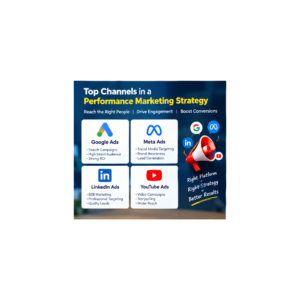
Choosing the Right Advertising Platform

Different platforms can serve different purposes.
Google Ads
Google Ads can help businesses reach users actively searching for products or services.
Search campaigns can be particularly useful when there is existing demand.
Businesses can target relevant keywords and send users to specific landing pages.
Meta Ads
Meta advertising can help businesses reach audiences based on interests, behaviors, demographics, engagement, and other available targeting signals.
It can be useful for discovery, visual storytelling, lead generation, ecommerce, remarketing, and promotional campaigns.
LinkedIn Ads
LinkedIn can be relevant for B2B campaigns where professional characteristics are important to the targeting strategy.
Businesses can reach specific professional audiences depending on campaign objectives and available targeting options.
YouTube Advertising
Video advertising can help businesses communicate complex products, demonstrate services, educate audiences, and build awareness.
The right platform depends on your audience, offer, creative assets, funnel, and business objective.
Creating the Right Offer
Advertising can bring people to your business, but the offer determines what happens next.
An offer could be:
- Free consultation
- Discount
- Demo
- Free trial
- Downloadable guide
- Product bundle
- Limited promotion
- Free audit
- Appointment
A Performance Marketing Strategy should make the offer relevant to the audience and campaign stage.
A cold audience may respond better to educational value, while a high-intent audience may be more interested in a direct purchase or consultation.
Creating High-Converting Ad Creative
Your advertisement needs to communicate value quickly.
Strong creative generally answers three questions:
What is the problem?
What is the solution?
Why should the user care?
For example:
Problem: Getting leads but struggling to convert them?
Solution: Build a data-driven acquisition system.
Action: Book a strategy consultation.
Different creative formats can be tested, including:
- Static images
- Carousels
- Short videos
- Reels
- Testimonials
- Product demonstrations
- UGC-style creatives
- Educational videos
Creative testing is a major part of a Performance Marketing Strategy because audience response can change over time.
Landing Pages Matter
Sending paid traffic to a poorly designed landing page can waste advertising budget.
The landing page should match the advertisement.
If an advertisement promotes “Google Ads Management,” the landing page should clearly explain Google Ads management rather than forcing users to search through a generic homepage.
A strong landing page may include:
- Clear headline
- Strong value proposition
- Benefits
- Social proof
- Testimonials
- Case studies
- FAQs
- Relevant visuals
- Clear CTA
- Simple form
The landing page should make the next action obvious.
Conversion Tracking
Without reliable tracking, optimization becomes difficult.
Businesses should track the actions that matter.
Depending on the business, these might include:
- Form submissions
- Purchases
- Calls
- Bookings
- Sign-ups
- Downloads
- Add-to-cart events
- Checkout events
A Performance Marketing Strategy should be built around meaningful conversion data rather than vanity metrics alone.
Important Performance Marketing Metrics
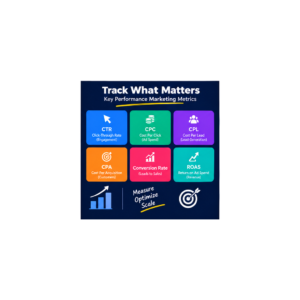
CTR
Click-through rate measures how frequently users click an advertisement after seeing it.
A low CTR may indicate that the creative, message, offer, or audience needs improvement.
CPC
Cost per click measures the average amount paid for each click.
CPL
Cost per lead measures how much it costs to generate a lead.
This can be especially important for service businesses.
CPA
Cost per acquisition measures the cost of acquiring a customer or desired conversion.
Conversion Rate
Conversion rate shows what percentage of visitors complete the desired action.
ROAS
Return on ad spend compares revenue generated with advertising expenditure.
For example, if a business spends ₹20,000 on ads and generates ₹80,000 in attributed revenue, the ROAS would be 4.
These metrics help marketers understand different parts of the acquisition system.
Budget Planning
Budget should be connected to business economics.
Suppose a company earns ₹10,000 in gross profit from an average customer.
If the business can acquire that customer profitably at a lower cost, advertising can potentially become scalable.
However, the calculation should consider actual margins, operational costs, refunds, repeat purchases, and customer lifetime value.
A Performance Marketing Strategy should therefore consider profitability, not just lead volume.
Customer Acquisition Cost
Customer acquisition cost, or CAC, measures how much a business spends to acquire customers.
A simple formula is:
CAC = Total Acquisition Cost ÷ Number of New Customers
Understanding CAC can help businesses evaluate whether campaigns are economically sustainable.
Generating 1,000 leads does not automatically mean a campaign is successful if those leads rarely become customers.
Lead Quality Matters
One of the biggest mistakes in performance marketing is focusing only on the number of leads.
Imagine Campaign A generates 100 leads and Campaign B generates 40 leads.
At first glance, Campaign A looks stronger.
But if Campaign A produces only 2 customers while Campaign B produces 10 customers, the second campaign may be producing more valuable outcomes.
A good Performance Marketing Strategy should therefore measure lead quality and downstream conversion.
Retargeting
Many users do not convert during their first interaction.
Retargeting can help businesses reconnect with people who previously interacted with their website, content, products, or advertisements, subject to platform rules and privacy requirements.
Retargeting audiences can include people who:
- Visited the website
- Viewed a product
- Added an item to cart
- Started checkout
- Watched a video
- Engaged with social content
Different audiences can receive different messages based on their previous interaction.
Funnel-Based Advertising
A complete Performance Marketing Strategy should consider the customer journey.
A simple funnel can look like:
Awareness → Interest → Consideration → Conversion → Retention
At the awareness stage, educational or problem-focused content may be useful.
At the consideration stage, businesses can introduce case studies, comparisons, demonstrations, and testimonials.
At the conversion stage, direct offers and strong calls to action can help users take action.
After conversion, retention campaigns can encourage repeat purchases or long-term relationships.
A/B Testing
A/B testing involves comparing different versions of an element to determine which performs better.
You can test:
- Headlines
- Images
- Videos
- CTAs
- Offers
- Landing pages
- Forms
- Audience segments
- Ad copy
However, testing should be structured.
Changing everything simultaneously makes it difficult to understand what caused the performance difference.
A better approach is to establish a clear hypothesis and test meaningful variables.
Common Performance Marketing Mistakes
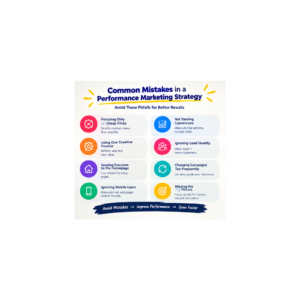
Focusing Only on Cheap Clicks
Cheap traffic is not necessarily valuable traffic.
The objective should be meaningful business outcomes.
Using One Creative Forever
Audience fatigue can reduce engagement.
Refreshing creative and testing new angles can help maintain campaign effectiveness.
Sending Everyone to the Homepage
Specific campaigns should generally lead to relevant destinations.
Ignoring Mobile Users
A large portion of digital traffic comes through mobile devices.
Landing pages should therefore be mobile-friendly.
Not Tracking Conversions
Without conversion tracking, campaign optimization becomes much harder.
Ignoring Lead Quality
More leads do not always mean more customers.
Changing Campaigns Too Frequently
Constant changes can make it difficult to understand campaign performance and may disrupt learning systems on advertising platforms.
How to Optimize a Performance Marketing Campaign
Optimization should be based on data.
Start by identifying where the biggest problem exists.
For example:
Low impressions → Check targeting, demand, budget, or eligibility.
Low CTR → Review creative, messaging, audience, or offer.
High clicks but low conversions → Review landing page and offer.
Many leads but few customers → Review lead quality, qualification, sales process, and targeting.
Good sales but poor profitability → Review CAC, margins, average order value, and retention.
This diagnostic approach makes a Performance Marketing Strategy more systematic.
Performance Marketing for Ecommerce
Ecommerce businesses can use performance marketing across the customer journey.
A typical ecommerce system may include:
Paid Ads → Product Page → Add to Cart → Checkout → Purchase → Retention
Important metrics include:
- ROAS
- CPA
- Conversion rate
- Average order value
- Cart abandonment
- Customer lifetime value
- Repeat purchase rate
Creative testing is also important because product presentation can significantly affect user response.
Performance Marketing for Service Businesses
Service businesses often focus on lead generation.
Examples include:
- Digital marketing agencies
- Web development companies
- Real estate businesses
- Coaching businesses
- Educational institutions
- Professional services
The funnel could be:
Advertisement → Landing Page → Lead Form → Qualification → Sales Call → Customer
Here, lead quality becomes especially important.
A low-cost lead that never responds may be less valuable than a more expensive lead with a high probability of becoming a customer.
Performance Marketing for Small Businesses
Small businesses often have limited advertising budgets.
That makes measurement particularly important.
Instead of running campaigns across every platform, businesses can start with one or two channels where their audience is most relevant.
They can then collect data, optimize campaigns, and gradually expand.
A practical Performance Marketing Strategy should match the business’s budget, sales capacity, margins, and customer acquisition goals.
AI and Performance Marketing
Artificial intelligence is increasingly being integrated into digital advertising platforms.
AI can support areas such as:
- Audience optimization
- Creative generation
- Bidding
- Predictive analysis
- Automated placements
- Campaign recommendations
- Content variations
However, marketers still need to provide strong strategy, accurate conversion signals, useful creative concepts, and appropriate business constraints.
AI can accelerate optimization, but the quality of the underlying strategy still matters.
Building a Complete Performance Marketing Strategy
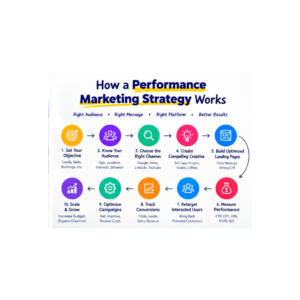
A practical framework can look like this:
Step 1: Define the Business Goal
Decide whether you want leads, sales, bookings, subscriptions, or another measurable outcome.
Step 2: Identify the Audience
Understand the people most likely to become customers.
Step 3: Select the Channel
Choose platforms based on audience behavior and campaign objective.
Step 4: Create the Offer
Give users a clear reason to take action.
Step 5: Develop Creative
Create multiple concepts and formats.
Step 6: Build the Landing Page
Make the page relevant, clear, fast, and conversion-focused.
Step 7: Install Tracking
Measure meaningful actions.
Step 8: Launch
Start with a controlled budget and sufficient data collection.
Step 9: Analyze
Review metrics at each stage of the funnel.
Step 10: Optimize
Improve targeting, creative, offer, landing pages, and conversion processes.
Step 11: Scale Carefully
Increase budget when the campaign demonstrates sustainable economics.
How to Scale Performance Marketing
Scaling is not simply increasing the advertising budget.
Before scaling, businesses should understand:
- Conversion rates
- Customer acquisition cost
- Profit margins
- Lead quality
- Sales capacity
- Customer lifetime value
- Campaign stability
If increasing spend significantly reduces efficiency, the business may need to improve its funnel before increasing the budget further.
Scaling can involve:
- Increasing budget
- Testing new audiences
- Expanding creative
- Introducing new channels
- Improving landing pages
- Increasing average order value
- Improving retention
Future of Performance Marketing
Performance marketing is becoming increasingly data-driven and automated.
Advertising platforms are using more machine learning to optimize campaigns, while businesses are collecting more detailed first-party data.
At the same time, privacy changes are influencing how marketers collect and use customer information.
Future marketers will need to combine:
Data + Creative + Strategy + Technology + Customer Experience
The businesses that can connect these areas effectively can build more efficient acquisition systems.
Advanced Performance Marketing Strategy: Turning Data Into Sustainable Growth
A successful Performance Marketing Strategy should go beyond running advertisements. It should connect advertising with the complete customer journey, including the website, sales process, customer experience, and retention. When these areas work together, businesses can understand not only where customers come from, but also why some campaigns produce stronger commercial results.
Build a Complete Acquisition System
A Performance Marketing Strategy should create a clear path from the first interaction to the final purchase. After someone clicks an advertisement, the visitor should immediately understand the offer, find relevant information, and know what action to take.
Businesses should examine the entire journey:
Advertisement → Landing Page → Lead or Purchase → Sales Process → Customer → Retention
If a campaign generates many leads but sales remain low, increasing the advertising budget may not solve the problem. The issue could be lead quality, slow follow-up, pricing, the offer, or the sales process.
Improve Audience Segmentation
Audience segmentation can make a Performance Marketing Strategy more precise. Instead of treating everyone as one audience, marketers can separate people according to intent, behavior, location, product interest, or previous interactions.
For example, a first-time visitor may need educational content, while someone who has visited a pricing page may need testimonials or a direct offer. Existing customers can receive completely different communication from new prospects.
Relevant segmentation helps businesses create more useful campaigns and reduce unnecessary advertising exposure.
Connect Creative With Customer Problems
A Performance Marketing Strategy should evaluate creative based on the problem it solves, not just how attractive it looks.
Marketers can test different angles such as:
- Saving time
- Reducing costs
- Improving convenience
- Increasing results
- Solving a specific customer problem
- Demonstrating product benefits
One campaign may use an educational message, while another uses a customer story or direct offer. Performance data can show which message connects with the intended audience.
Optimize Landing Pages
A landing page should continue the conversation started by the advertisement. If an ad promotes a specific service but the landing page provides only general information, visitors may leave.
A Performance Marketing Strategy should maintain consistency between the advertisement and landing page.
Important elements include:
- Clear headline
- Relevant offer
- Strong benefits
- Social proof
- Simple navigation
- Mobile-friendly design
- Clear call to action
- Short and relevant forms
Page speed and mobile usability should also be monitored because unnecessary friction can reduce conversions.
Measure Business Value
A Performance Marketing Strategy should distinguish between activity and actual business value. Impressions, clicks, and engagement can help diagnose campaigns, but they are not always the final objective.
For ecommerce, useful metrics may include revenue, profit margin, average order value, repeat purchases, and customer lifetime value.
For service businesses, qualified leads, sales opportunities, closed deals, and revenue per customer may provide more useful information.
The goal is to understand whether advertising contributes to sustainable business growth.
Improve Lead Quality
A Performance Marketing Strategy should measure the quality of leads, not only the number of leads.
Imagine one campaign generates 200 enquiries while another generates 70. If the first campaign produces very few customers and the second produces many, the smaller campaign may be creating more valuable opportunities.
Lead qualification can consider location, budget, business type, requirements, purchase timeline, and intent.
Marketing and sales teams should also communicate regularly about which leads become customers and why.
Strengthen Follow-Up
Generating a lead is only the beginning. A Performance Marketing Strategy should include a clear follow-up process.
Depending on the business, this may involve email, phone calls, messaging, appointment scheduling, or automated communication.
Speed matters because interested prospects may contact multiple businesses at the same time. A well-organized follow-up system can help businesses respond consistently and reduce opportunities being lost after the initial conversion.
Use Retention to Improve Economics
A Performance Marketing Strategy should not end when someone becomes a customer.
Businesses can increase customer value through repeat purchases, upgrades, subscriptions, complementary products, loyalty programs, and referral opportunities.
When customers continue generating value after the first transaction, acquisition costs can become easier to justify. This is why customer lifetime value should be considered alongside customer acquisition cost.
Create a Structured Testing Process
A Performance Marketing Strategy becomes stronger when testing is based on clear hypotheses.
For example:
Hypothesis: A benefit-focused headline will generate more qualified leads than a feature-focused headline.
Test: Compare two landing page headlines.
Primary metric: Qualified lead conversion rate.
Secondary metrics: Cost per lead and lead-to-customer rate.
This approach helps marketers learn from experiments instead of making random changes.
Avoid Making Decisions Too Quickly
A Performance Marketing Strategy should not be changed dramatically based on a very small amount of data.
Short-term performance can change because of competition, seasonality, audience behavior, creative fatigue, platform changes, or normal variation.
Marketers should evaluate meaningful data before making major decisions while still responding quickly to obvious technical problems or serious performance issues.
Build Useful Reports
A good Performance Marketing Strategy report should help answer business questions.
A useful report can include:
- Advertising spend
- Leads
- Qualified leads
- Customers
- Cost per acquisition
- Revenue
- Return on ad spend
- Conversion rate
- Customer lifetime value
Numbers should be accompanied by observations and next actions. A report is more useful when it explains what changed and what the team should test next.
Align Marketing and Sales
A Performance Marketing Strategy works better when marketing and sales share the same understanding of a qualified lead.
Sales teams can provide information about common objections, customer questions, pricing concerns, and lead quality.
Marketing teams can use this feedback to improve advertisements, landing pages, content, and offers.
This creates a feedback loop where customer conversations improve future advertising.
Refresh Creative Regularly
A Performance Marketing Strategy should include a creative testing and refresh system.
Audiences may become less responsive when they repeatedly see the same advertisement. New hooks, visuals, formats, testimonials, demonstrations, and customer stories can provide fresh opportunities.
However, creative refreshes should still be based on previous learning. A strong concept can be adapted into several variations rather than discarded completely.
Use Data Responsibly
Customer data can improve personalization and campaign analysis, but a Performance Marketing Strategy should use data responsibly.
Businesses should understand what information they collect, why they collect it, and how it is used. They should also follow applicable privacy requirements and advertising platform policies.
Responsible data practices can support customer trust while helping marketers make better decisions.
Build a Scalable System
A Performance Marketing Strategy should eventually become a repeatable process rather than a collection of isolated campaigns.
A useful cycle is:
Research → Create → Launch → Measure → Learn → Optimize → Retain → Scale
Every cycle should produce new information about audiences, messages, offers, landing pages, and customer behavior.
Over time, businesses can identify patterns and allocate resources toward areas that demonstrate sustainable value.
The Role of AI and Automation
AI and automation are becoming increasingly important in performance marketing. They can support creative variations, audience analysis, campaign optimization, reporting, and repetitive workflows.
However, a Performance Marketing Strategy still requires human judgment. Marketers need to define the business objective, evaluate data quality, understand customers, and decide which recommendations make sense.
Automation should make a good process faster, not hide a weak strategy.
Scaling Without Losing Efficiency
Scaling a Performance Marketing Strategy does not simply mean increasing the daily advertising budget.
Before scaling, businesses should understand acquisition costs, conversion rates, margins, sales capacity, lead quality, and customer lifetime value.
Scaling can also involve testing new audiences, launching new creative, expanding to additional channels, improving the offer, and increasing repeat purchases.
A controlled approach can help businesses learn whether growth remains sustainable as spending increases.
Build Better Connections Between Marketing Channels
A Performance Marketing Strategy becomes more powerful when different marketing channels support one another instead of operating independently.
For example, SEO can attract users who are actively searching for information, while paid advertising can reach people who may not yet know the brand. Social media can support engagement, email can nurture prospects, and remarketing can reconnect with previous visitors.
This connected approach allows businesses to create multiple touchpoints throughout the customer journey.
Instead of asking which individual channel is responsible for everything, marketers can evaluate how different channels contribute to the overall acquisition process.
Understand the Difference Between Traffic and Demand
Traffic is not the same as demand.
A website can receive thousands of visitors without generating significant business results if those visitors are not relevant to the offer.
A Performance Marketing Strategy should therefore focus on attracting people who have a genuine connection with the product, service, or problem being solved.
Keyword intent, audience behavior, creative messaging, geographic targeting, and offer relevance can all influence traffic quality.
Better traffic can make the rest of the conversion system more effective.
Improve the Offer Before Increasing the Budget
When campaign performance is weak, marketers sometimes immediately increase spending or change platforms.
However, the problem may be the offer itself.
A Performance Marketing Strategy should evaluate whether the customer has a compelling reason to take action.
An offer can become stronger through clearer benefits, better positioning, easier access, stronger guarantees where appropriate, relevant bonuses, improved packaging, or a more direct explanation of the value.
A stronger offer can improve results without requiring a proportionate increase in advertising expenditure.
Use Customer Feedback as Marketing Data
Customer feedback can reveal valuable information that standard advertising dashboards cannot provide.
Sales calls, reviews, support tickets, comments, surveys, and direct conversations can reveal what customers like, what they dislike, what confuses them, and what nearly stopped them from purchasing.
A Performance Marketing Strategy can use these insights to improve advertisements and landing pages.
For example, if customers repeatedly mention one specific benefit after purchasing, that benefit could become a stronger advertising message.
If prospects frequently ask the same question before buying, that question could be addressed directly in the landing page or advertisement.
Create a Consistent Measurement Framework
A Performance Marketing Strategy should use consistent definitions across campaigns.
For example, the business should clearly define what counts as a lead, qualified lead, customer, conversion, and profitable acquisition.
Without consistent definitions, reports from different campaigns may become difficult to compare.
A standardized measurement framework makes it easier to identify trends and understand whether changes are producing meaningful improvements.
Consider Seasonality
A Performance Marketing Strategy should account for seasonal behavior.
Customer demand can change during holidays, festivals, special events, product launches, financial periods, or industry-specific seasons.
Some businesses may experience their highest demand during certain months, while others may experience predictable periods of lower activity.
Understanding these patterns can help businesses plan budgets, creative, offers, inventory, and sales capacity more effectively.
Build a Culture of Continuous Learning
A Performance Marketing Strategy should create a culture where campaign data is treated as a source of learning rather than simply a scorecard.
Every campaign can teach marketers something about:
- Audience preferences
- Creative angles
- Customer objections
- Pricing
- Offers
- Landing pages
- Purchase behavior
- Retention
Even a campaign that does not achieve its target can provide useful information if the team understands why the result occurred.
This mindset turns marketing into an ongoing learning process.
Connect Short-Term Results With Long-Term Growth
A Performance Marketing Strategy should balance immediate performance with long-term business objectives.
A campaign might generate quick sales, but marketers should also consider customer satisfaction, repeat purchases, brand perception, and lifetime value.
Similarly, an awareness campaign may not produce immediate sales but could introduce a new audience to the brand.
Looking at both short-term and long-term outcomes creates a more complete understanding of marketing performance.
Final Takeaway
The strongest Performance Marketing Strategy combines creative thinking, accurate measurement, customer understanding, and continuous optimization.
Advertising is only one part of the system. A business can have excellent ads but poor results if the landing page is confusing. It can have strong traffic but weak revenue if the offer does not match customer needs. It can generate many leads but few customers if the sales process is ineffective.
A complete Performance Marketing Strategy therefore looks at the entire journey rather than one campaign metric.
The objective is to build a system where marketing data creates useful learning, learning improves future campaigns, and better campaigns produce stronger customer outcomes.
Businesses should continually ask:
Who are we targeting?
Why should they care?
What action do we want them to take?
What happens after they convert?
Are those customers profitable?
What can we improve next?
When these questions are answered consistently, a Performance Marketing Strategy becomes more than an advertising method. It becomes a measurable growth framework.
The long-term objective of a Performance Marketing Strategy is not simply to generate more clicks or spend more budget. It is to create an adaptable acquisition system that improves through testing, measurement, customer feedback, and responsible scaling.
With the right process, businesses can make better use of their advertising budgets, understand their customers more clearly, and create a stronger connection between marketing activity and real business results.
A mature Performance Marketing Strategy also depends on clear communication between creative, media buying, analytics, website, and sales teams. When each team understands the same objective, campaign decisions become easier to coordinate.
Another important part of a Performance Marketing Strategy is understanding customer feedback. Comments, sales calls, support questions, reviews, and objections can reveal information that dashboards cannot always show. These insights can improve future messaging.
A flexible Performance Marketing Strategy should also leave room for seasonal changes. Consumer demand can change during holidays, festivals, product launches, sales periods, and industry events. Campaign budgets and creative may need to adapt accordingly.
Finally, a Performance Marketing Strategy should always connect short-term campaign results with long-term business goals. A campaign that produces immediate conversions may still need to be evaluated against profitability, retention, customer experience, and sustainable growth.
A disciplined Performance Marketing Strategy also creates a culture of continuous learning. Every campaign can reveal something about the audience, the offer, the creative, or the customer journey.
The best Performance Marketing Strategy is therefore not a fixed formula. It is a process that evolves as customer behavior, competition, technology, and business priorities change.
With consistent measurement and optimization, a Performance Marketing Strategy can become a dependable part of a company’s broader digital growth engine.
Final Thoughts
A Performance Marketing Strategy is not simply a collection of advertisements.
It is a complete system connecting business objectives, audiences, creative, offers, landing pages, tracking, conversion, optimization, and customer economics.
The most important lesson is to focus on business outcomes rather than surface-level metrics.
Clicks can be useful.
Impressions can be useful.
Reach can be useful.
But ultimately, businesses need customers, revenue, and sustainable growth.
A strong strategy helps marketers understand where advertising is working, where users are dropping off, and what needs to be improved.
The process should be continuous:
Research → Launch → Measure → Learn → Optimize → Scale
When businesses follow this process consistently, paid advertising becomes less about guesswork and more about measurable decision-making.
The goal of modern performance marketing is not simply to spend more money.
It is to build a system where every marketing investment has a measurable purpose and where campaign data is continuously used to improve future decisions.
That is what makes a Performance Marketing Strategy an important part of modern digital marketing.