Digital Marketing

Social Media Marketing

Social Media Marketing: A Complete Guide to Growing Your Brand in 2026

Social media has become one of the most important digital channels for businesses that want to build visibility, connect with customers, and generate consistent demand. Whether you run a local business, an ecommerce store, a personal brand, a startup, or a service company, the right strategy can turn social platforms into a valuable business asset. This complete guide explains how to build a practical social strategy from the ground up. You will learn about audience research, platform selection, content planning, engagement, paid campaigns, analytics, lead generation, brand building, common mistakes, and ways to improve results over time. What Is Social Media Marketing? Social Media Marketing is the process of using social platforms to promote a business, communicate with an audience, distribute valuable content, generate leads, support sales, and strengthen brand relationships. It can include organic content, community management, influencer collaborations, paid advertising, short-form video, social commerce, and performance measurement. The biggest advantage is that businesses can communicate with people where they already spend time. Instead of depending on one-way advertising, brands can publish useful information, answer questions, collect feedback, and create ongoing conversations. A successful approach is not simply about posting every day. It connects content with a clear business objective and gives the audience a reason to pay attention. Why Social Media Marketing Matters for Businesses Social Media Marketing can support several stages of the customer journey. At the awareness stage, content can introduce your brand to new people. During consideration, educational posts, demonstrations, reviews, and case studies can help prospects understand your offer. At the decision stage, strong calls to action, testimonials, offers, and retargeting can encourage conversions. Social platforms also create a direct feedback loop. Comments, messages, shares, saves, and questions reveal what customers care about. This information can improve not only your content but also your products, offers, website, and customer service. Another important benefit is distribution. A useful post can reach existing followers and potentially travel beyond them through shares and recommendations. This makes social channels useful for both established brands and businesses that are still building awareness. Main Goals of a Social Media Strategy Before creating content, define what the business wants social channels to accomplish. Social Media Marketing becomes easier to manage when every activity connects to a measurable goal. 1. Brand Awareness The objective is to increase recognition among a relevant audience. Educational posts, visual storytelling, short videos, founder content, and memorable brand messages can help people understand who you are. 2. Engagement and Community Engagement is more than collecting likes. Comments, shares, saves, replies, direct messages, and meaningful conversations can indicate that the content is relevant. 3. Lead Generation Businesses can use social content, lead forms, landing pages, direct messages, webinars, downloads, and offers to turn audience attention into prospects. 4. Sales and Revenue For ecommerce and service businesses, the ultimate objective may be purchases, bookings, consultations, or qualified enquiries. Content should make the next step clear. 5. Customer Retention Existing customers can remain connected through useful updates, support content, product education, loyalty campaigns, and community experiences. Know Your Target Audience Good Social Media Marketing starts with understanding the people you want to reach. A broad audience may look attractive, but content becomes stronger when it is built around specific customer needs. Identify demographic factors such as age range, location, profession, purchasing power, and business type when relevant. Then go deeper into interests, problems, motivations, objections, buying triggers, and preferred content formats. Create simple audience personas. For example, a digital marketing agency may target a small-business owner who wants more qualified leads but does not understand advertising, analytics, or content strategy. That person needs practical education rather than technical jargon. Also study existing customers. Look at frequently asked questions, sales conversations, reviews, support requests, and common objections. These are excellent sources for content ideas because they reflect real customer language. Choose the Right Social Platforms You do not need to be active on every platform. Social Media Marketing works more efficiently when you focus on channels that match your audience, content style, and business goals. Instagram Instagram is useful for visual storytelling, short-form video, carousels, product showcases, creator collaborations, and community interaction. It can be especially useful for lifestyle, fashion, food, design, fitness, events, and personal brands. Facebook Facebook remains useful for community-based communication, local businesses, groups, events, content distribution, and paid campaigns. Its advertising ecosystem can also support different stages of the customer journey. LinkedIn LinkedIn is valuable for B2B companies, professional services, recruitment, thought leadership, founder branding, and business networking. Educational posts, industry insights, case studies, and professional stories can perform well. YouTube YouTube can support long-form education, tutorials, reviews, demonstrations, interviews, and searchable video content. Short-form video can also be used to attract attention and move viewers toward deeper content. TikTok and Short-Form Video Platforms Short-form video can help brands communicate ideas quickly through demonstrations, storytelling, trends, education, and entertainment. The key is to adapt content to the audience rather than copying every trend. Build Strong Content Pillars Content pillars make Social Media Marketing more organized. Instead of deciding what to publish every morning, create a few repeatable themes. A strong content system can include: Educational content that solves audience problems Product or service content that explains your offer Social proof such as testimonials and case studies Behind-the-scenes content that humanizes the brand Industry insights and opinions Entertainment or relatable content Promotional content with clear offers A useful balance prevents the profile from becoming a constant sales pitch. People usually follow accounts because they receive value, inspiration, information, entertainment, or a sense of community. Create a Social Media Content Calendar A content calendar turns ideas into a repeatable publishing system. Start by deciding how many posts, videos, stories, or other formats you can realistically create each week. For example, a simple weekly plan could include educational content on Monday, a short video on Tuesday, a customer story on Wednesday, a behind-the-scenes post on Thursday, a useful carousel on Friday, and a promotional message on Saturday. The exact

Social Media Marketing: A Complete Guide to Growing Your Brand in 2026 Read More »
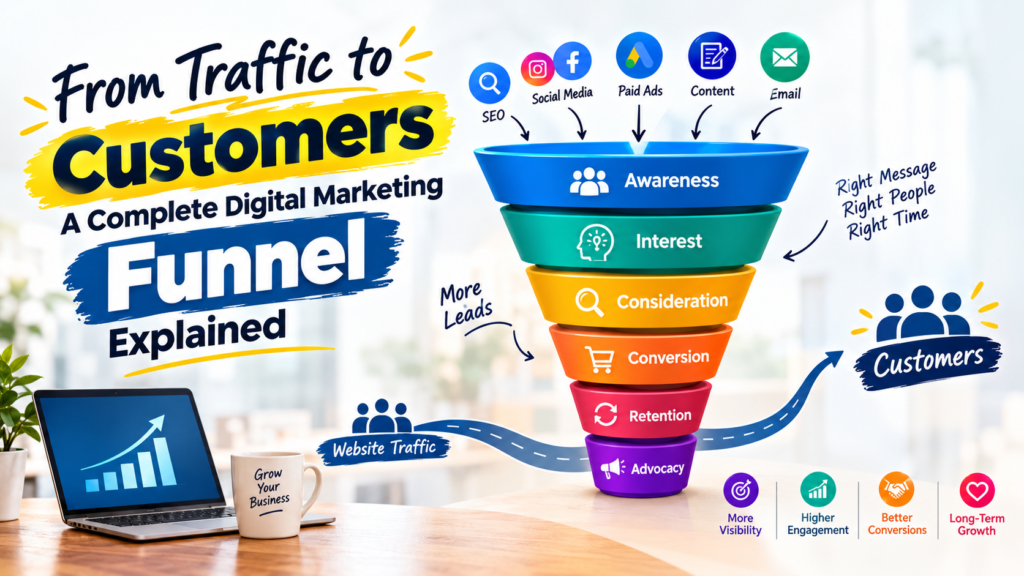
Marketing Funnel

From Traffic to Customers: A Complete Digital Marketing Funnel Explained

Getting website traffic is one of the first goals of digital marketing, but traffic alone does not generate revenue. A business can attract thousands of visitors and still struggle to generate leads or sales if there is no clear process for converting those visitors into customers. This is where a Marketing Funnel becomes important. A well-designed funnel helps businesses understand how people discover a brand, become interested in its products or services, evaluate their options, make a purchase, and eventually become repeat customers. Instead of treating every visitor the same, a Marketing Funnel allows businesses to create different strategies for people at different stages of the customer journey. For example, someone discovering your brand for the first time may need educational content, while someone who has already visited your pricing page may need a testimonial, comparison, or special offer before making a decision. Understanding this journey can help businesses create better content, more relevant advertising campaigns, stronger landing pages, and more effective follow-up strategies. In this complete guide, we will explain how a Marketing Funnel works, its different stages, the role of SEO, social media, paid advertising, email marketing, content marketing, retargeting, conversion optimization, and how businesses can build a practical funnel that turns traffic into customers. What Is a Marketing Funnel? A Marketing Funnel is a framework that represents the journey a potential customer takes from discovering a business to becoming a customer and, ideally, a loyal advocate. The funnel is commonly divided into several stages: Awareness → Interest → Consideration → Conversion → Retention → Advocacy At the top, businesses attract people who may not know about the brand. In the middle, those visitors begin researching and evaluating the available options. At the bottom, qualified prospects take an action such as purchasing a product, booking a service, requesting a quotation, or signing up for a subscription. After conversion, the relationship should continue through customer service, retention campaigns, loyalty programs, and personalized communication. A Marketing Funnel therefore goes beyond simply generating website traffic. Its purpose is to move people from awareness toward meaningful business outcomes. Why Is a Marketing Funnel Important? Many businesses focus heavily on traffic, impressions, followers, and clicks. These metrics can be useful, but they do not automatically translate into revenue. A Marketing Funnel helps connect marketing activities with the customer journey. Suppose an online store receives 20,000 monthly visitors but only generates a small number of purchases. The problem may not be traffic. It could be weak product pages, unclear offers, lack of trust signals, poor follow-up, complicated checkout processes, or visitors arriving with low purchase intent. A funnel allows marketers to identify these gaps. For example: Traffic is low → improve SEO, content, and advertising. Engagement is low → improve messaging and creative. Product interest is low → improve positioning and offers. Conversion is low → optimize landing pages and checkout. Repeat purchases are low → improve retention and customer communication. This makes a Marketing Funnel useful for both marketing strategy and business analysis. The Main Stages of a Marketing Funnel Stage 1: Awareness The awareness stage is the top of the funnel. At this stage, people may not know your business exists. They may be searching for information, researching a problem, watching videos, scrolling social media, or discovering brands through recommendations. The objective is to attract attention without immediately forcing a sale. SEO, social media, educational videos, blogs, podcasts, influencer marketing, digital advertising, and other discovery channels can support awareness. A strong Marketing Funnel starts by understanding what the target audience is searching for and what problems they want to solve. For example, a person searching for “how to improve Instagram engagement” may not yet be looking for a marketing agency. An agency can attract that person through useful educational content and gradually introduce its services. Content for Awareness Useful awareness-stage content includes: Blog articles Educational videos Social media posts Infographics Industry reports Beginner guides Podcasts Short-form videos Search-optimized informational pages The goal is to provide value and create initial brand awareness. Stage 2: Interest Once someone discovers your business, the next challenge is keeping their attention. This is the interest stage. The visitor may read multiple articles, follow your social media profile, watch videos, explore your website, or subscribe to your email list. At this stage, businesses need to demonstrate expertise and relevance. A Marketing Funnel should provide content that answers the audience’s questions and helps them understand the problem more clearly. For example, a web development company can publish content about website speed, mobile optimization, SEO, landing pages, and conversion optimization. This content gives potential customers reasons to continue exploring the business. Stage 3: Consideration At the consideration stage, potential customers are actively evaluating solutions. They may compare different businesses, check pricing, read reviews, explore case studies, and research product features. This is where trust becomes extremely important. A strong Marketing Funnel should provide evidence that helps customers make informed decisions. Useful consideration-stage assets include: Case studies Customer testimonials Product comparisons Demonstrations Detailed service pages FAQs Pricing information Webinars Free consultations Product guides Businesses should answer the questions that could prevent someone from purchasing. Stage 4: Conversion The conversion stage is where a prospect takes the desired action. Depending on the business, that action could be: Purchasing a product Booking an appointment Requesting a quote Filling out a lead form Calling the business Starting a free trial Subscribing to a service A Marketing Funnel should make this stage as simple as possible. A confusing website, lengthy form, unclear pricing, weak call-to-action, or lack of trust can cause potential customers to leave. Strong conversion pages usually include: Clear headlines Strong value proposition Relevant benefits Social proof Simple navigation Strong calls to action Trust signals Easy contact options The fewer unnecessary obstacles a customer encounters, the easier it becomes for them to take action. The Role of SEO in a Marketing Funnel SEO can contribute to multiple stages of a Marketing Funnel. At the awareness stage, informational keywords can attract people who

From Traffic to Customers: A Complete Digital Marketing Funnel Explained Read More »

Small Business Growth

How Digital Marketing Helps Small Businesses Growth in a Competitive Market

How Digital Marketing Helps Small Businesses Grow in a Competitive Market Running a small business in today’s competitive market is challenging. Customers have more choices, competitors are constantly improving their online presence, and traditional marketing alone may not be enough to attract attention. This is where digital marketing has become an important growth tool for modern businesses. For small companies, Small Business Growth depends heavily on visibility, customer trust, consistent communication, and the ability to reach the right audience. Digital marketing provides businesses with multiple channels to build awareness, generate leads, increase sales, and develop long-term customer relationships. Unlike traditional advertising, digital marketing allows businesses to reach specific audiences, measure campaign performance, test different strategies, and adjust their approach based on real results. In this complete guide, we will explore how digital marketing supports Small Business Growth, which strategies small businesses should focus on, common mistakes to avoid, and how businesses can build a sustainable digital marketing strategy. Why Digital Marketing Matters for Small Businesses Small businesses often operate with limited budgets and smaller teams. They need marketing strategies that can generate measurable results without requiring the same resources as large corporations. Digital marketing gives smaller businesses access to search engines, social media platforms, email marketing, content marketing, paid advertising, and other digital channels. A strong online presence can contribute significantly to Small Business Growth because customers increasingly research businesses online before making purchasing decisions. Whether someone is searching for a local restaurant, graphic designer, marketing agency, clothing brand, consultant, or service provider, appearing in the right digital channels can create valuable opportunities. 1. Build a Strong Online Presence The first step toward Small Business Growth is creating a professional online presence. Your website is often the foundation of this presence. It should clearly explain what your business offers, who you serve, why customers should choose you, and how they can contact you. A good website should also be mobile-friendly, fast, easy to navigate, and optimized for search engines. Social media profiles can support your website by giving customers additional ways to discover your brand and interact with your business. The goal is not simply to be present everywhere. The goal is to create a consistent and trustworthy digital identity that supports Small Business Growth. 2. SEO Helps Customers Find Your Business Search engine optimization is one of the most valuable long-term digital marketing strategies for smaller companies. When potential customers search for products or services related to your business, SEO can help your website appear in relevant search results. For example, a local web development company could target keywords related to website development services in its city. A fitness business could create content around local fitness-related searches. Effective SEO can support Small Business Growth by bringing relevant organic traffic to a website without paying for every individual visitor. SEO includes several areas such as: Keyword research On-page optimization Technical SEO Local SEO Content creation Internal linking Website performance Link building A consistent SEO strategy can gradually improve visibility and contribute to sustainable Small Business Growth. 3. Local SEO Can Attract Nearby Customers For businesses serving specific locations, local SEO is particularly important. A local customer may search for phrases such as “digital marketing agency near me,” “best salon in Delhi,” or “restaurants near me.” Optimizing your Google Business Profile, maintaining accurate business information, collecting genuine customer reviews, and creating location-specific content can help businesses improve their local visibility. For many service-based companies, local SEO can become a major source of leads and support Small Business Growth. Businesses should make sure that their name, address, phone number, opening hours, website, and service information are accurate across important platforms. 4. Social Media Marketing Builds Brand Awareness Social media gives small businesses an opportunity to communicate directly with potential customers. Platforms such as Instagram, Facebook, LinkedIn, YouTube, and other social networks can help businesses showcase products, share educational content, demonstrate expertise, publish customer stories, and build communities. Social media can support Small Business Growth by increasing brand awareness and keeping the business visible to potential customers. However, simply posting content is not enough. Businesses need a clear content strategy. A useful social media strategy can include: Educational posts Short-form videos Customer testimonials Behind-the-scenes content Product demonstrations Industry tips FAQs Offers and promotions Case studies Consistency and relevance are usually more important than posting large quantities of low-quality content. 5. Content Marketing Builds Trust People do not always purchase immediately after discovering a business. They often research, compare options, and look for information before making a decision. Content marketing can help businesses answer customer questions before the sales conversation begins. Blogs, videos, guides, infographics, social posts, and case studies can demonstrate knowledge and provide useful information. This makes content marketing an important component of Small Business Growth. For example, a digital marketing agency could publish articles about SEO, paid advertising, social media management, and website optimization. These articles can attract people who are actively looking for marketing information. Over time, useful content can help a business build authority and attract qualified visitors. 6. Paid Advertising Can Deliver Faster Visibility SEO and content marketing can take time. Paid advertising can provide businesses with another way to reach potential customers quickly. Platforms such as Google Ads and Meta Ads allow businesses to target audiences based on different characteristics and behaviors. Paid advertising can support Small Business Growth when campaigns are carefully planned and continuously optimized. A business should not simply spend money on advertisements without understanding its goals. Campaign objectives could include: Website traffic Lead generation Product sales App installations Phone calls Brand awareness Appointment bookings Businesses should track metrics such as cost per lead, conversion rate, customer acquisition cost, and return on advertising spend. 7. Email Marketing Creates Repeat Customers Getting a new customer is only part of business growth. Keeping existing customers engaged can be equally valuable. Email marketing allows businesses to communicate directly with people who have already shown interest. Businesses can send newsletters, product updates, educational content, special offers, reminders,

How Digital Marketing Helps Small Businesses Growth in a Competitive Market Read More »

Digital Marketing Guide

What Is Digital Marketing? A Complete Digital Marketing Guide for Businesses in 2026

Digital marketing has become one of the most important ways for businesses to reach customers, build their brand, generate leads, and increase revenue. Whether you are running a small local business, an e-commerce store, a startup, or an established company, having a strong online marketing strategy is no longer optional. This Digital Marketing Guide will help you understand what digital marketing is, how it works, the different types of digital marketing, why businesses need it, and how you can create an effective strategy in 2026. The digital landscape is constantly changing. Search engines are becoming smarter, social media platforms are evolving, artificial intelligence is transforming marketing workflows, and customers are expecting more personalized experiences. This makes it important for businesses to understand the fundamentals before investing in different marketing channels. If you are looking for a practical Digital Marketing Guide that explains everything from SEO and social media to performance marketing, content marketing, email marketing, and analytics, you are in the right place. What Is Digital Marketing? Digital marketing refers to the promotion of products, services, brands, or businesses through digital channels and technologies. These channels can include: Search engines Social media platforms Websites Email Online advertising Video platforms Mobile applications Content platforms Online marketplaces Unlike traditional marketing, digital marketing allows businesses to reach specific audiences, measure campaign performance, analyze customer behavior, and optimize marketing activities based on data. A good Digital Marketing Guide should not focus only on advertising. Digital marketing covers the complete customer journey—from discovering a brand to researching a product, making a purchase, and eventually becoming a repeat customer. For example, someone might discover a company through Google, visit its website, follow the brand on Instagram, watch one of its videos, click a Google advertisement, and eventually become a customer. That entire journey can involve multiple digital marketing channels working together. Why Is Digital Marketing Important for Businesses? One of the biggest advantages of digital marketing is its ability to connect businesses with highly relevant audiences. Traditional advertising often reaches a broad audience, while digital marketing allows businesses to target people based on factors such as interests, demographics, location, search behavior, and online activity. According to this Digital Marketing Guide, some of the biggest benefits include: 1. Reach a Larger Audience The internet allows businesses to reach customers beyond their local geographical area. A small business can potentially attract customers from different cities, states, or even countries. 2. Target the Right Customers Platforms such as Google and Meta provide advertising tools that allow businesses to target specific audience segments. 3. Measure Results Digital campaigns can be tracked using metrics such as impressions, clicks, conversions, cost per lead, return on ad spend, and website traffic. 4. Build Brand Awareness Consistent content across search engines and social media can help businesses establish a recognizable online presence. 5. Generate Leads Digital marketing can help businesses attract potential customers through websites, landing pages, forms, advertisements, social media, and other channels. 6. Increase Sales A properly planned digital marketing strategy can move potential customers through the buying journey and ultimately increase conversions. 7. Improve Customer Relationships Businesses can communicate directly with customers through social media, email, messaging platforms, and content. Types of Digital Marketing A complete Digital Marketing Guide should cover the major areas of digital marketing because each channel serves a different purpose. Here are the most important types of digital marketing businesses should understand. 1. Search Engine Optimization (SEO) Search Engine Optimization, commonly known as SEO, is the process of improving a website so that it can appear more prominently in search engine results. For example, if someone searches for: “digital marketing agency near me” businesses that have optimized their websites may have an opportunity to appear in the search results. SEO generally includes: Keyword research On-page SEO Technical SEO Content optimization Internal linking Website performance Backlink building Local SEO SEO is particularly valuable because it can generate organic traffic without paying for every individual click. A strong Digital Marketing Guide must include SEO because search engines remain an important discovery channel for businesses. 2. Social Media Marketing Social media marketing involves promoting a business through platforms such as Instagram, Facebook, LinkedIn, YouTube, TikTok, and other relevant networks. Businesses use social media to: Build brand awareness Publish content Engage with audiences Generate leads Promote products Share educational content Build communities Drive website traffic Social media is not simply about posting frequently. Successful social media marketing requires a clear strategy, consistent branding, valuable content, audience understanding, and performance analysis. For many businesses, social media becomes an important part of their overall Digital Marketing Guide because it combines branding, communication, content, and lead generation. 3. Performance Marketing Performance marketing focuses on measurable actions and results. These actions may include: Website visits Leads App installations Purchases Registrations Phone calls Form submissions Common performance marketing channels include Google Ads, Meta Ads, display advertising, shopping campaigns, and other paid digital advertising platforms. One of the biggest advantages of performance marketing is that businesses can monitor campaign performance and make adjustments based on data. For example, if one advertising campaign generates leads at a lower cost than another, marketers can analyze the results and adjust their budgets and targeting accordingly. This is why performance marketing deserves an important place in any modern Digital Marketing Guide. 4. Content Marketing Content marketing involves creating and distributing valuable content to attract and engage a target audience. Examples include: Blog posts Videos Infographics Guides Case studies E-books Social media posts Podcasts Tutorials Instead of directly promoting a product in every piece of content, content marketing focuses on answering questions, solving problems, educating customers, and building trust. For example, a digital marketing agency could publish an article explaining how businesses can improve their online presence. This content can attract people who are actively searching for marketing information and potentially turn them into future customers. 5. Email Marketing   Email marketing allows businesses to communicate directly with people who have subscribed to their email lists. Businesses can use email marketing

What Is Digital Marketing? A Complete Digital Marketing Guide for Businesses in 2026 Read More »

Digital marketing Agency ai

The Future of Digital Marketing Agency: Ai,Trends, Technology, and Growth

The digital landscape is changing faster than ever. Businesses that once relied primarily on traditional advertising are now investing heavily in online channels to reach customers, build awareness, generate leads, and increase sales. As technology continues to evolve, the role of a Digital Marketing Agency is becoming increasingly important for businesses of every size. A modern Digital Marketing Agency is no longer limited to managing social media accounts or running paid advertisements. Today, a Digital Marketing Agency can combine search engine optimization, content marketing, artificial intelligence, data analytics, automation, social media, email marketing, influencer marketing, and conversion optimization to create complete digital growth strategies. The future of the Digital Marketing Agency industry will be shaped by technological innovation, changing customer expectations, privacy regulations, artificial intelligence, and the growing demand for personalized experiences. Companies that understand these changes will be better positioned to compete in an increasingly digital economy. In this article, we will explore the future of the Digital Marketing Agency, the technologies transforming the industry, emerging trends, and what businesses should expect from digital marketing services in the coming years. What Is a Digital Marketing Agency? A Digital Marketing Agency is a company that helps businesses promote their products, services, and brands through digital channels. These channels can include search engines, websites, social media platforms, email, online advertising, content platforms, and other internet-based technologies. A traditional may offer services such as SEO, pay-per-click advertising, social media marketing, content creation, email marketing, web development, and analytics. However, the modern Digital Marketing Agency is evolving into a strategic growth partner. Instead of simply executing individual campaigns, a forward-thinking Digital Marketing Agency uses customer data, technology, automation, and creative strategies to understand audiences and improve business performance. This transformation is one of the biggest reasons the future of the Digital Marketing Agency industry looks increasingly technology-driven. Why the Future of Digital Marketing Agency Is Important Consumer behavior has changed dramatically. People search for information online, compare products through websites and social media, read reviews, watch videos, and communicate with brands through digital platforms. As customers spend more time online, businesses need a strong digital presence. This creates opportunities for a Digital Marketing Agency to help organizations reach their target audiences more effectively. The future Digital Marketing Agency will focus less on simply generating traffic and more on generating measurable business outcomes. Leads, sales, customer lifetime value, retention, engagement, and brand loyalty will become increasingly important performance indicators. Businesses will also expect their Digital Marketing Agency partners to understand technology, data, consumer psychology, branding, and business strategy. Artificial Intelligence and the Future of Digital Marketing Agency Artificial intelligence is one of the most important technologies shaping the future of marketing. A modern Digital Marketing Agency can use AI to analyze large amounts of data, identify patterns, generate content ideas, automate repetitive tasks, personalize customer experiences, and improve campaign optimization. AI can help a Digital Marketing Agency understand which audiences are responding to particular messages and which marketing channels are producing meaningful results. However, artificial intelligence will not eliminate the need for human creativity. Instead, the future Digital Marketing Agency will combine AI-powered tools with human strategy, creativity, storytelling, and critical thinking. AI can produce information quickly, but marketers still need to understand brand identity, customer emotions, cultural context, and business objectives. This means the successful Digital Marketing Agency of the future will likely be one that knows how to use AI responsibly rather than simply relying on AI-generated output. Automation Will Transform Digital Marketing Marketing automation is another major trend that will influence the future of the Digital Marketing Agency. Businesses can automate many repetitive marketing activities, including email campaigns, customer segmentation, lead nurturing, reporting, audience targeting, and certain customer communication processes. A technology-focused Digital Marketing Agency can use automation to save time while maintaining consistency across multiple channels. For example, when a potential customer downloads a guide from a website, an automated system can send a series of relevant emails designed to educate the prospect and move them toward a purchase decision. The future Digital Marketing Agency will increasingly use automation to create connected customer journeys rather than isolated campaigns. Data-Driven Marketing Will Become More Important Data has always been important in marketing, but its role will become even more significant. A data-driven Digital Marketing Agency can examine website traffic, customer behavior, conversion rates, advertising performance, search trends, and other measurable signals. Instead of making decisions based purely on assumptions, a Digital Marketing Agency can use data to determine which strategies are working and where improvements are needed. However, data collection is also becoming more complicated because consumers increasingly care about privacy. Future marketing strategies will need to balance personalization with responsible data practices. The successful Digital Marketing Agency will therefore need strong analytical capabilities as well as an understanding of privacy and compliance requirements. Personalization Will Define Customer Experiences Consumers increasingly expect brands to provide relevant experiences. Generic marketing messages may not attract the same level of attention as personalized communication. A future Digital Marketing Agency will use customer insights to create more relevant content, advertisements, email campaigns, product recommendations, and website experiences. Personalization can help brands communicate with different customer segments according to their interests, needs, behaviors, and stages in the buying journey. For a Digital Marketing Agency, personalization will become less of an optional strategy and more of an important part of customer experience management. The Growth of Voice Search and Conversational Marketing Search behavior is also changing. Consumers increasingly interact with digital assistants, smart devices, chatbots, and conversational interfaces. A forward-thinking Digital Marketing Agency will need to understand how people ask questions conversationally and how businesses can provide useful answers. Conversational marketing can include chatbots, messaging platforms, AI assistants, and interactive customer support. For the Digital Marketing Agency, this means traditional keyword-focused strategies will increasingly be complemented by strategies designed around questions, intent, context, and useful information. Search Engine Optimization Is Evolving SEO will remain an important service for a Digital Marketing Agency, but the nature of

The Future of Digital Marketing Agency: Ai,Trends, Technology, and Growth Read More »