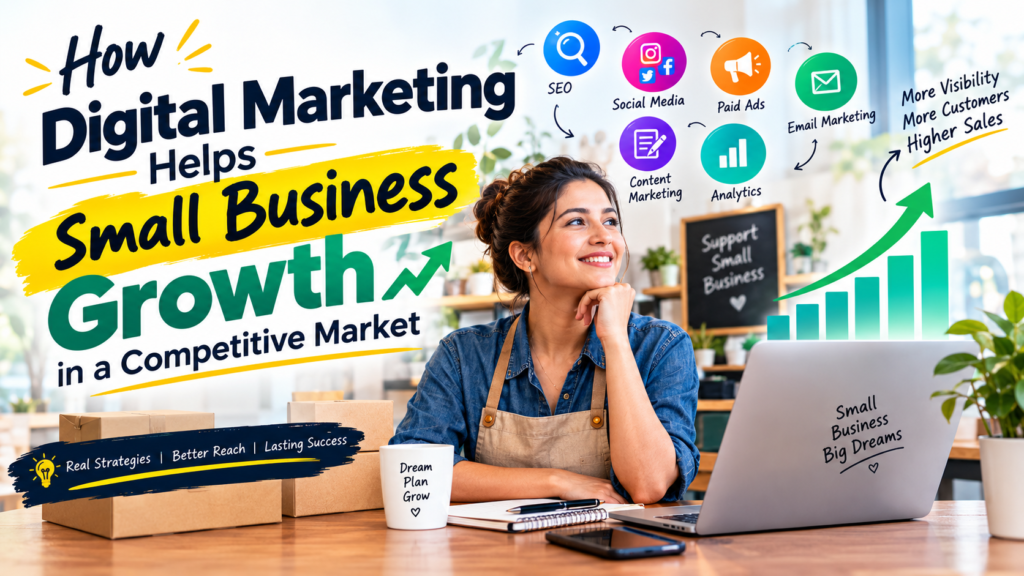
How Digital Marketing Helps Small Businesses Grow in a Competitive Market
Running a small business in today’s competitive market is challenging. Customers have more choices, competitors are constantly improving their online presence, and traditional marketing alone may not be enough to attract attention. This is where digital marketing has become an important growth tool for modern businesses.
For small companies, Small Business Growth depends heavily on visibility, customer trust, consistent communication, and the ability to reach the right audience. Digital marketing provides businesses with multiple channels to build awareness, generate leads, increase sales, and develop long-term customer relationships.
Unlike traditional advertising, digital marketing allows businesses to reach specific audiences, measure campaign performance, test different strategies, and adjust their approach based on real results.
In this complete guide, we will explore how digital marketing supports Small Business Growth, which strategies small businesses should focus on, common mistakes to avoid, and how businesses can build a sustainable digital marketing strategy.
Why Digital Marketing Matters for Small Businesses
Small businesses often operate with limited budgets and smaller teams. They need marketing strategies that can generate measurable results without requiring the same resources as large corporations.
Digital marketing gives smaller businesses access to search engines, social media platforms, email marketing, content marketing, paid advertising, and other digital channels.
A strong online presence can contribute significantly to Small Business Growth because customers increasingly research businesses online before making purchasing decisions.
Whether someone is searching for a local restaurant, graphic designer, marketing agency, clothing brand, consultant, or service provider, appearing in the right digital channels can create valuable opportunities.
1. Build a Strong Online Presence
The first step toward Small Business Growth is creating a professional online presence.
Your website is often the foundation of this presence. It should clearly explain what your business offers, who you serve, why customers should choose you, and how they can contact you.
A good website should also be mobile-friendly, fast, easy to navigate, and optimized for search engines.
Social media profiles can support your website by giving customers additional ways to discover your brand and interact with your business.
The goal is not simply to be present everywhere. The goal is to create a consistent and trustworthy digital identity that supports Small Business Growth.
2. SEO Helps Customers Find Your Business
Search engine optimization is one of the most valuable long-term digital marketing strategies for smaller companies.
When potential customers search for products or services related to your business, SEO can help your website appear in relevant search results.
For example, a local web development company could target keywords related to website development services in its city. A fitness business could create content around local fitness-related searches.
Effective SEO can support Small Business Growth by bringing relevant organic traffic to a website without paying for every individual visitor.
SEO includes several areas such as:
- Keyword research
- On-page optimization
- Technical SEO
- Local SEO
- Content creation
- Internal linking
- Website performance
- Link building
A consistent SEO strategy can gradually improve visibility and contribute to sustainable Small Business Growth.
3. Local SEO Can Attract Nearby Customers
For businesses serving specific locations, local SEO is particularly important.
A local customer may search for phrases such as “digital marketing agency near me,” “best salon in Delhi,” or “restaurants near me.”
Optimizing your Google Business Profile, maintaining accurate business information, collecting genuine customer reviews, and creating location-specific content can help businesses improve their local visibility.
For many service-based companies, local SEO can become a major source of leads and support Small Business Growth.
Businesses should make sure that their name, address, phone number, opening hours, website, and service information are accurate across important platforms.
4. Social Media Marketing Builds Brand Awareness
Social media gives small businesses an opportunity to communicate directly with potential customers.
Platforms such as Instagram, Facebook, LinkedIn, YouTube, and other social networks can help businesses showcase products, share educational content, demonstrate expertise, publish customer stories, and build communities.
Social media can support Small Business Growth by increasing brand awareness and keeping the business visible to potential customers.
However, simply posting content is not enough. Businesses need a clear content strategy.
A useful social media strategy can include:
- Educational posts
- Short-form videos
- Customer testimonials
- Behind-the-scenes content
- Product demonstrations
- Industry tips
- FAQs
- Offers and promotions
- Case studies
Consistency and relevance are usually more important than posting large quantities of low-quality content.
5. Content Marketing Builds Trust
People do not always purchase immediately after discovering a business. They often research, compare options, and look for information before making a decision.
Content marketing can help businesses answer customer questions before the sales conversation begins.
Blogs, videos, guides, infographics, social posts, and case studies can demonstrate knowledge and provide useful information.
This makes content marketing an important component of Small Business Growth.
For example, a digital marketing agency could publish articles about SEO, paid advertising, social media management, and website optimization. These articles can attract people who are actively looking for marketing information.
Over time, useful content can help a business build authority and attract qualified visitors.
6. Paid Advertising Can Deliver Faster Visibility
SEO and content marketing can take time. Paid advertising can provide businesses with another way to reach potential customers quickly.
Platforms such as Google Ads and Meta Ads allow businesses to target audiences based on different characteristics and behaviors.
Paid advertising can support Small Business Growth when campaigns are carefully planned and continuously optimized.
A business should not simply spend money on advertisements without understanding its goals.
Campaign objectives could include:
- Website traffic
- Lead generation
- Product sales
- App installations
- Phone calls
- Brand awareness
- Appointment bookings
Businesses should track metrics such as cost per lead, conversion rate, customer acquisition cost, and return on advertising spend.
7. Email Marketing Creates Repeat Customers
Getting a new customer is only part of business growth. Keeping existing customers engaged can be equally valuable.
Email marketing allows businesses to communicate directly with people who have already shown interest.
Businesses can send newsletters, product updates, educational content, special offers, reminders, and personalized recommendations.
Email marketing can contribute to Small Business Growth by encouraging repeat purchases and maintaining relationships with existing customers.
For example, an ecommerce business can send a follow-up email after a purchase and recommend related products.
A service business can send helpful tips and reminders to previous customers.
The key is to provide value rather than sending promotional messages constantly.
8. Digital Marketing Makes Customer Targeting More Precise
One of the biggest advantages of digital marketing is the ability to target specific audiences.
Traditional advertising may reach a large number of people who have no interest in a product or service. Digital campaigns can often be targeted according to location, interests, search behavior, demographics, previous interactions, and other available signals.
Better targeting can make marketing budgets more efficient and contribute to Small Business Growth.
Businesses should begin by clearly defining their ideal customer.
Ask questions such as:
- Who needs this product or service?
- What problem are they trying to solve?
- Where do they search for solutions?
- What objections might prevent them from buying?
- What type of content do they consume?
- What makes them choose one business over another?
Understanding the customer makes every marketing channel more effective.
9. Reviews and Testimonials Build Trust
Trust is extremely important for small businesses.
A potential customer may compare several companies before making a decision. Reviews and testimonials can provide social proof that helps reduce uncertainty.
Businesses should encourage satisfied customers to leave genuine reviews on appropriate platforms.
Testimonials can also be displayed on websites, landing pages, social media, and promotional materials.
Strong customer feedback can support Small Business Growth because new customers are often more comfortable choosing a business when they can see evidence of positive experiences.
Businesses should never manufacture fake reviews. Authenticity is important for long-term reputation.
10. Conversion Optimization Turns Traffic Into Customers
Getting visitors to your website does not automatically create revenue.
A business needs to guide visitors toward a meaningful action.
This could be:
- Filling out a form
- Making a purchase
- Booking an appointment
- Calling the business
- Requesting a quotation
- Signing up for an email list
Conversion rate optimization focuses on improving these actions.
Better headlines, clearer calls to action, stronger offers, simpler forms, better page layouts, faster websites, and stronger trust signals can all improve conversion performance.
This is important for Small Business Growth because increasing conversions can produce more customers from existing traffic.
11. Analytics Helps Businesses Make Better Decisions
One of the biggest advantages of digital marketing is measurability.
Businesses can track where website visitors come from, which pages they view, which campaigns generate leads, and where customers leave the conversion process.
Analytics can therefore play a major role in Small Business Growth.
Important metrics may include:
- Website traffic
- Organic traffic
- Conversion rate
- Cost per lead
- Customer acquisition cost
- Return on ad spend
- Engagement rate
- Email open rate
- Click-through rate
- Customer retention
The most important metrics depend on the business model and marketing objectives.
12. Digital Marketing Can Help Small Businesses Compete With Larger Brands
Large companies often have bigger budgets, larger teams, and stronger brand recognition.
However, small businesses can compete by focusing on specific audiences, specialized services, local markets, personalized customer experiences, and useful content.
A smaller company can build authority around a niche instead of trying to appeal to everyone.
This focused approach can create opportunities for Small Business Growth.
For example, instead of marketing itself as a general agency, a company might specialize in marketing for restaurants, real estate businesses, healthcare providers, ecommerce brands, or local service businesses.
Niche positioning can make marketing communication clearer and more relevant.
13. Video Marketing Can Increase Engagement
Video has become an important part of modern digital communication.
Short videos, tutorials, product demonstrations, customer stories, interviews, and educational videos can help businesses communicate complex ideas quickly.
Video content can support Small Business Growth by increasing engagement and helping potential customers understand products or services.
Businesses do not always need expensive production equipment. Clear messaging, useful information, good lighting, and consistent publishing can often matter more than expensive production.
14. Remarketing Helps Bring Customers Back
Not every visitor becomes a customer during their first interaction.
Remarketing allows businesses to reconnect with people who have previously interacted with their website, content, or advertisements, subject to applicable platform rules and privacy requirements.
This can be useful because someone who already knows a brand may require less education than someone discovering it for the first time.
Remarketing can support Small Business Growth by helping businesses stay connected with potential customers during longer decision-making processes.
Examples include showing relevant advertisements to previous website visitors or sending follow-up communications to people who have previously interacted with a business.
15. Common Digital Marketing Mistakes Small Businesses Should Avoid
While digital marketing provides many opportunities, businesses can waste time and money without a clear strategy.
One common mistake is trying to use every platform at once.
Another is focusing only on follower counts instead of meaningful business outcomes.
Some businesses also publish content without understanding their target audience.
Others spend money on advertisements without proper conversion tracking.
These mistakes can slow down Small Business Growth.
A better approach is to choose a few relevant channels, define measurable objectives, create useful content, monitor results, and continuously improve the strategy.
How to Create a Digital Marketing Strategy for Small Business Growth

A practical strategy can follow these steps:
Step 1: Define Your Business Goal
Decide what you want digital marketing to accomplish.
It could be more leads, sales, appointments, website traffic, or brand awareness.
Step 2: Understand Your Target Audience
Research your customers, their needs, problems, interests, objections, and buying behavior.
Step 3: Analyze Competitors
Study competitors to understand their positioning, content, SEO strategy, advertisements, offers, and customer communication.
Step 4: Select the Right Channels
You may not need every marketing channel. Choose the platforms where your target audience is most active.
Step 5: Create Useful Content
Build content around customer questions, problems, solutions, and buying decisions.
Step 6: Track Performance
Use analytics and reporting tools to understand what is producing results.
Step 7: Optimize Continuously
Keep testing headlines, advertisements, landing pages, content formats, audiences, and offers.
This structured process creates a stronger foundation for Small Business Growth.
How Much Should a Small Business Spend on Digital Marketing?
There is no universal marketing budget that works for every business.
The appropriate investment depends on factors such as revenue, industry, competition, customer acquisition cost, profit margins, business goals, and available resources.
A small business can begin with a focused strategy and gradually increase investment when it identifies channels that produce measurable results.
The objective should not simply be to spend more. It should be to understand which activities contribute to profitable Small Business Growth.
Businesses should also separate testing budgets from established campaigns so they can experiment without disrupting their core marketing activities.
The Future of Digital Marketing for Small Businesses
Digital marketing will continue evolving as technology, customer behavior, search, social media, automation, and artificial intelligence develop.
Small businesses will have access to increasingly sophisticated tools for analytics, content creation, customer segmentation, automation, advertising, and personalization.
This means Small Business Growth will increasingly depend on the ability to adapt and learn.
Businesses that regularly analyze customer behavior and update their strategies can respond more effectively to changing market conditions.
Artificial intelligence can also help small teams automate repetitive marketing activities and analyze large amounts of information.
However, technology will not replace the importance of strong offers, customer service, positioning, creativity, and trust.
Building a Long-Term Digital Growth Strategy
Digital marketing should not be treated as a one-time campaign. For small businesses, sustainable Small Business Growth usually comes from consistent execution, regular measurement, and continuous improvement. A business may not see dramatic results immediately, but a well-planned strategy can gradually create stronger visibility, better customer relationships, and a more predictable flow of opportunities.
One of the first priorities should be building a strong digital foundation. This includes a professional website, optimized social media profiles, accurate business information, conversion-focused landing pages, analytics tracking, and a clear brand identity. These foundations create the environment necessary for long-term Small Business Growth.
Focus on Quality Over Quantity
Small businesses often make the mistake of trying to publish content everywhere. Managing multiple social platforms, writing blogs, running advertisements, sending emails, and creating videos simultaneously can become overwhelming.
A better approach is to identify the channels that are most relevant to the target audience.
For example, a B2B service company may receive more value from LinkedIn, search engines, email marketing, and educational content. A visual consumer brand may benefit more from Instagram, YouTube, short-form video, influencer collaborations, and paid social campaigns.
The objective should always be relevance rather than simply increasing the number of platforms. This focused approach can make marketing resources more efficient and support sustainable Small Business Growth.
Create a Strong Customer Journey
Marketing should guide customers through different stages rather than immediately asking every visitor to purchase.
A typical customer journey can include:
Awareness → Interest → Consideration → Conversion → Retention → Advocacy
At the awareness stage, businesses can use social media, SEO, videos, and educational content to attract attention.
During consideration, detailed guides, testimonials, case studies, product demonstrations, and comparison content can help potential customers understand the value of an offer.
At the conversion stage, strong landing pages, clear calls to action, offers, trust signals, and easy contact options can make it easier for customers to take action.
After conversion, email marketing, customer support, loyalty programs, and personalized communication can encourage repeat purchases and referrals.
Creating this complete customer journey can strengthen Small Business Growth because it focuses not only on acquiring customers but also on retaining them.
Keep Testing and Improving
Digital marketing provides businesses with continuous feedback. Companies can test different headlines, advertisements, images, videos, landing pages, offers, keywords, and calls to action.
For example, if one advertisement generates significantly more qualified leads than another, the business can study what made that version effective. It could be the message, visual, offer, audience, or call to action.
This creates a continuous improvement cycle:
Launch → Measure → Learn → Optimize → Test Again
Over time, small improvements across multiple areas can have a meaningful impact on Small Business Growth.
Businesses should avoid assuming that one successful campaign will continue performing forever. Customer behavior, competitors, platforms, and market conditions can change. Regular testing helps companies remain adaptable.
Build Trust Before Asking for the Sale
Modern customers have access to more information than ever before. They can compare competitors, read reviews, watch videos, check social media profiles, and research a company’s reputation before making a decision.
For this reason, businesses should focus on building trust throughout their online presence.
Clear pricing information, professional design, genuine testimonials, useful content, transparent communication, customer reviews, case studies, and responsive customer service can all contribute to credibility.
A business that consistently demonstrates expertise and provides useful information can create stronger relationships with potential customers. Stronger trust can directly support Small Business Growth by reducing uncertainty during the buying process.
Use Data to Guide Marketing Decisions
Small businesses do not need massive amounts of data to make better marketing decisions. Even basic information can reveal useful patterns.
Businesses can monitor which pages receive the most traffic, which content generates engagement, which keywords attract visitors, which advertisements generate leads, and which channels contribute to conversions.
Instead of making decisions based only on assumptions, businesses can use this information to determine where to focus their resources.
Data-driven decision-making can improve Small Business Growth because it allows businesses to invest more time and money into strategies that demonstrate meaningful results.
Build a Strong Brand Identity
Marketing is not only about generating immediate sales. It is also about creating a recognizable brand.
A consistent visual identity, tone of voice, messaging style, color palette, and customer experience can help customers remember a business.
Small businesses should clearly communicate what makes them different. This could be specialized expertise, better customer service, unique products, faster delivery, local knowledge, personalized experiences, or a specific niche.
Strong positioning can make it easier for customers to understand why they should choose one business over another. Over time, brand recognition can become an important part of Small Business Growth.
Make Marketing a Business Function
The most successful small businesses do not treat marketing as something separate from the rest of the company. Marketing should connect with sales, customer service, product development, branding, and overall business objectives.
Sales teams can provide information about customer objections. Customer support teams can identify frequently asked questions. Marketing teams can turn those insights into content and campaigns.
Business owners can then use performance data to decide where additional resources should be invested.
This creates a connected system where every customer interaction can contribute to better marketing decisions and stronger Small Business Growth.
Stay Consistent With Content
Content marketing can produce stronger results when businesses publish consistently rather than creating content only when they have spare time.
A practical content calendar can include blogs, short videos, social media posts, educational graphics, FAQs, case studies, customer stories, and industry insights.
The content should always have a purpose. It may answer a customer question, solve a problem, explain a product, demonstrate expertise, or move a potential buyer closer to a decision.
Consistent and useful content can gradually build authority and visibility, creating additional opportunities for Small Business Growth.
Make Marketing a Long-Term Investment
One of the biggest mistakes businesses make is expecting immediate results from every marketing activity.
Some channels, such as paid advertising, can generate results quickly, while SEO, content marketing, social media communities, and brand building often require more time.
Businesses should therefore evaluate marketing according to realistic timeframes.
Instead of asking whether a strategy produced instant results, businesses should also ask:
- Is website visibility improving?
- Are qualified visitors increasing?
- Are leads becoming more relevant?
- Are conversion rates improving?
- Is customer retention increasing?
- Is the brand becoming more recognizable?
Looking at these broader indicators provides a more complete understanding of Small Business Growth.
Final Conclusion
The competitive digital marketplace creates challenges for small businesses, but it also creates opportunities that were previously difficult to access. A business with a limited budget can now reach highly specific audiences, publish valuable content, build a recognizable brand, communicate directly with customers, and measure the results of its activities.
The key is not to chase every new platform or marketing trend. Instead, businesses should understand their audience, establish clear goals, choose suitable channels, create useful experiences, and consistently measure what works.
Digital marketing becomes most powerful when it is treated as a long-term growth system rather than a collection of disconnected promotional activities.
For small businesses willing to learn, test, adapt, and stay consistent, the digital environment can provide a strong foundation for attracting new customers and building lasting relationships.
The businesses that succeed will not necessarily be those that spend the most. They will be the ones that understand their customers best, communicate their value clearly, deliver excellent experiences, and continuously improve their marketing based on real data.
In a competitive market, consistency can become a major advantage. Every useful article, helpful social media post, optimized webpage, positive customer review, successful campaign, and meaningful customer interaction can contribute to stronger Small Business Growth.
Ultimately, sustainable growth comes from combining the right strategy with consistent execution. When marketing, customer experience, branding, analytics, and business goals work together, small businesses can create a digital presence that continues generating opportunities long after a single campaign has ended.
The most important lesson is that Small Business Growth does not happen because of one advertisement, one social media post, or one SEO campaign. It comes from combining multiple activities into a clear and consistent system.
Businesses that continuously learn about their customers, improve their digital presence, create valuable content, measure performance, and adapt to market changes can build a much stronger foundation for Small Business Growth.
As competition continues increasing, having a digital presence will become less of an option and more of a basic requirement. The businesses that use digital marketing strategically can create more opportunities to be discovered, trusted, contacted, and remembered.
With patience, consistency, customer-focused communication, and data-driven decision-making, digital marketing can become one of the most important tools supporting long-term Small Business Growth.
Final Thoughts
Digital marketing has changed the way small businesses compete.
A company no longer needs a massive advertising budget to build an audience. With the right strategy, a small business can use SEO, content marketing, social media, paid advertising, email marketing, video, local search, analytics, and conversion optimization to reach potential customers.
The key to Small Business Growth is not using every available digital channel. It is understanding customers, choosing the right platforms, communicating valuable information, measuring performance, and improving consistently.
A successful digital marketing strategy should be treated as a long-term business investment rather than a short-term promotional activity.
When businesses combine a strong online presence with customer-focused messaging and measurable marketing strategies, they can create more opportunities to attract, convert, and retain customers.
Ultimately, Small Business Growth comes from creating real value for customers and making that value easy to discover online.
The competitive market will continue to change, but businesses that remain customer-focused, data-driven, adaptable, and consistent can build a stronger foundation for sustainable growth.
Pingback: Marketing Funnel: Avoid Losing Leads and Customers 2026