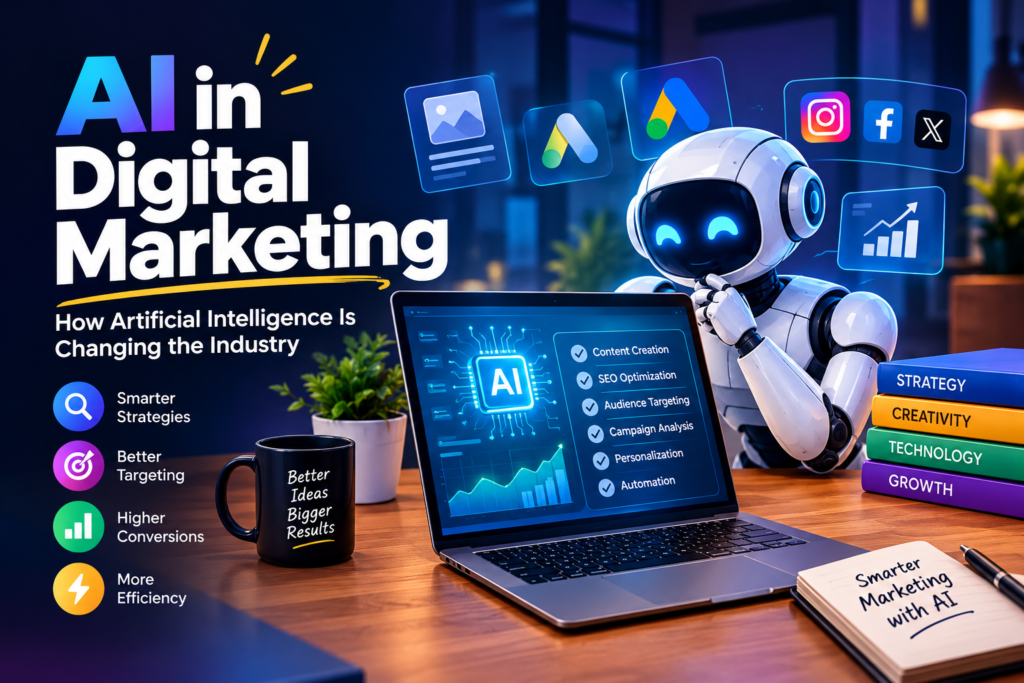
Artificial intelligence is no longer limited to research labs or advanced technology companies. It is becoming an important part of how businesses understand customers, create content, automate repetitive work, optimize advertising, and improve online experiences. Ai in Digital Marketing is helping marketers move from manual decision-making toward faster, data-driven, and increasingly personalized strategies.
For businesses of every size, Ai in Digital Marketing can support activities ranging from customer research and content planning to paid advertising, search optimization, email marketing, analytics, and customer service. The goal is not simply to replace human marketers. Instead, the strongest approach combines artificial intelligence with human creativity, strategy, judgment, and brand understanding.
In this guide, we will explore what Ai in Digital Marketing means, how it works, its major applications, benefits, limitations, practical use cases, and the future of AI-powered marketing.
What Is Ai in Digital Marketing?

Understanding Ai in Digital Marketing starts with recognizing that AI is a marketing capability, not a single software product.
Ai in Digital Marketing refers to the use of artificial intelligence technologies to analyze information, identify patterns, automate marketing tasks, generate or assist with content, predict customer behavior, and improve marketing decisions.
Traditional digital marketing often requires marketers to manually collect data, analyze campaigns, create variations, segment audiences, and optimize activities. AI can process large amounts of information much faster and help marketers identify patterns that may be difficult to discover manually.
Examples include AI-assisted content creation, predictive analytics, recommendation systems, conversational chatbots, automated audience segmentation, campaign optimization, sentiment analysis, and personalized customer experiences.
Ai in Digital Marketing does not mean that every marketing activity needs to be fully automated. In many cases, AI works best as a decision-support and productivity layer that helps people work faster and make better-informed decisions.
Why Is AI Becoming Important in Marketing?
The digital marketing environment has become increasingly complex. Customers interact with brands across search engines, websites, social networks, video platforms, email, messaging applications, and other digital channels.
Marketers therefore have to manage large amounts of data and create relevant experiences across multiple touchpoints. Ai in Digital Marketing can help organize this complexity by processing data, identifying patterns, and automating repetitive workflows.
Another reason for its growth is the increasing expectation for personalization. Customers often expect brands to understand their interests and provide useful information at the right time. AI can help marketers create different experiences for different audience segments without manually building every variation.
At the same time, AI tools are becoming easier to access. Small businesses, agencies, freelancers, and large organizations can use AI-powered software for research, writing assistance, analytics, customer support, and campaign management.
For agencies, Ai in Digital Marketing can connect research, campaign execution, reporting, and optimization into a more efficient workflow.
How Ai in Digital Marketing Is Changing the Industry
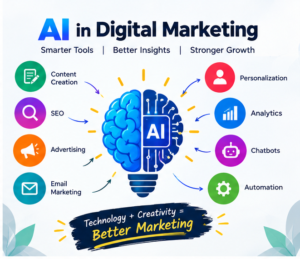
The biggest change is not one single tool. It is the way marketers approach planning, execution, optimization, and measurement.
Ai in Digital Marketing is changing the industry in several important areas.
1. AI-Powered Customer Research
Ai in Digital Marketing can help marketers analyze customer feedback, reviews, survey responses, search behavior, support conversations, and other available data to identify common themes.
Understanding the target audience is one of the foundations of effective marketing. AI can analyze large amounts of customer information and identify common questions, pain points, preferences, objections, and buying motivations.
For example, an ecommerce company can analyze thousands of customer reviews to identify frequently mentioned product benefits and complaints. Those findings can then influence landing pages, ad messaging, product descriptions, and content strategy.
2. Smarter Content Creation
Content marketing requires a constant flow of ideas, research, drafts, visuals, and distribution plans. Ai in Digital Marketing can accelerate many parts of this process.
AI tools can assist with brainstorming blog topics, creating outlines, generating first drafts, improving headlines, summarizing information, developing social media ideas, and adapting content for different channels.
However, human review remains important. AI-generated content can contain inaccurate information, repetitive language, generic ideas, or a tone that does not match the brand.
The most effective workflow is usually AI-assisted rather than completely AI-controlled: use AI for speed, then use human expertise for accuracy, originality, strategy, and brand voice.
3. Personalized Marketing
Personalization has become an important part of customer experience. Instead of showing the same message to everyone, brands can use data to create more relevant experiences.
Ai in Digital Marketing can help marketers segment audiences according to behavior, interests, purchase history, engagement, and other signals.
For example, an online store could show different product recommendations to a first-time visitor and a returning customer. An email campaign could also adapt its messaging according to previous interactions.
When implemented responsibly, personalization can make marketing communication more relevant and useful.
4. Better Advertising Optimization
Paid advertising involves constant monitoring and optimization. Marketers need to evaluate audiences, creatives, keywords, bids, placements, conversion rates, and other performance signals.
Ai in Digital Marketing can support this process by analyzing campaign data and identifying patterns that can inform optimization.
Advertising platforms already use machine learning in areas such as bidding, audience delivery, creative combinations, and conversion optimization. Marketers still need to define goals, provide suitable inputs, monitor performance, and make strategic decisions.
AI can therefore reduce some manual work while allowing marketers to focus more on campaign strategy and business objectives.
Another major application of Ai in Digital Marketing is creative testing, where marketers can develop and compare multiple concepts more efficiently.
5. Predictive Analytics
Traditional analytics often tells marketers what happened. Predictive analytics attempts to estimate what could happen next based on available data and patterns.
Ai in Digital Marketing can help businesses identify customers who may be more likely to purchase, churn, engage, or respond to a particular offer.
For example, a subscription business could analyze customer behavior to identify patterns associated with cancellation. The marketing team could then create targeted retention campaigns.
Predictions are not guarantees. Their usefulness depends on the quality of data, model design, business context, and ongoing validation.
6. AI Chatbots and Customer Support
Customer support is another area where AI is changing digital experiences. AI-powered chatbots can answer common questions, provide basic information, guide users through processes, and route complex requests to human agents.
Ai in Digital Marketing can connect marketing and customer service by helping visitors move from awareness to consideration and eventually toward conversion.
For example, a website chatbot might answer questions about services, pricing structures, delivery information, or appointment processes. A human representative can then handle questions requiring deeper judgment or personal assistance.
7. Search and SEO
Search behavior is evolving, and marketers need to understand how users discover information. AI can assist SEO professionals with keyword research, content clustering, search-intent analysis, competitor research, internal linking ideas, and content optimization.
Ai in Digital Marketing can also help teams analyze large content libraries and identify pages that need updates or improvements.
However, SEO is not simply about generating large amounts of AI content. Search visibility still depends on useful information, relevance, quality, technical performance, user experience, authority, and alignment with search intent.
8. Social Media Management
Social media teams often manage multiple platforms with different audiences and content formats. AI can assist with idea generation, caption drafting, content repurposing, scheduling workflows, comment analysis, and performance summaries.
Ai in Digital Marketing can help social media managers reduce repetitive tasks and spend more time on creative direction, community building, and strategic planning.
AI can also analyze engagement patterns to help identify which content themes are attracting attention. Human marketers should still decide what the brand should say and how it should respond to sensitive or complex conversations.
9. Email Marketing Automation
Email marketing becomes more effective when messages are relevant to the recipient. AI can help marketers analyze engagement patterns and support segmentation, subject-line testing, send-time optimization, recommendations, and personalized messaging.
Ai in Digital Marketing can make email campaigns more responsive by helping businesses deliver different messages based on customer behavior.
For example, a retailer can create different journeys for new subscribers, inactive customers, recent purchasers, and high-value customers.
10. Conversion Rate Optimization
Getting traffic is only one part of digital marketing. Businesses also need to convert visitors into leads, customers, subscribers, or other desired actions.
Ai in Digital Marketing can support conversion rate optimization by analyzing user behavior, identifying potential friction points, and generating ideas for testing.
AI may help teams examine landing-page performance, user journeys, form completion patterns, and conversion data. Marketers can then test different headlines, calls to action, layouts, offers, or page structures.
Testing remains essential because an AI-generated recommendation should be validated against real user behavior.
Customer journey analysis is also becoming an important part of Ai in Digital Marketing because businesses can study interactions across multiple touchpoints.
Benefits of Ai in Digital Marketing
The growing adoption of AI is driven by several practical benefits.
One practical advantage of Ai in Digital Marketing is the ability to turn complex information into useful marketing insights.
Faster Execution
AI can complete repetitive tasks in less time, allowing marketers to focus on strategy and creativity.
Better Data Analysis
Large datasets can be difficult to analyze manually. AI can identify patterns and relationships that support faster decision-making.
Greater Personalization
AI can help businesses create audience segments and experiences based on customer behavior and preferences.
Improved Productivity
Marketing teams can use AI to support research, content development, reporting, brainstorming, and workflow automation.
Scalable Marketing
Businesses can create and manage more marketing variations without increasing manual workload at the same rate.
Faster Optimization
AI-assisted systems can process campaign signals and help identify opportunities for improvement more quickly.
In ecommerce, Ai in Digital Marketing can support product recommendations, audience segmentation, promotional messaging, and retention campaigns.
For lead-generation campaigns, Ai in Digital Marketing can help teams identify patterns among leads and improve follow-up strategies.
Analytics dashboards are becoming more useful when Ai in Digital Marketing is used to summarize large volumes of campaign information.
Another growing area of Ai in Digital Marketing is automated reporting, which can reduce the time marketers spend preparing routine performance updates.
Challenges and Risks
Despite its potential, Ai in Digital Marketing also introduces important challenges.
Data Privacy
AI systems often depend on data. Businesses need responsible processes for collecting, storing, processing, and using customer information.
Accuracy
AI can produce incorrect or misleading information. Human review is important, especially for factual, financial, legal, medical, or brand-sensitive content.
Brand Consistency
Automatically generated content can sound generic. Brands need clear guidelines and human editing to maintain a consistent voice.
Over-Automation
Automation can save time, but excessive automation can make customer experiences feel impersonal.
Bias
AI systems can reproduce biases present in their training data or the data used to build marketing models. Teams need monitoring and appropriate safeguards.
Lack of Strategy
AI cannot fix a weak marketing strategy automatically. Businesses still need clear positioning, audience understanding, competitive differentiation, strong offers, and measurable objectives.
Responsible implementation is essential because Ai in Digital Marketing involves decisions about data, automation, personalization, and customer communication.
How Businesses Can Use AI Effectively
Successful AI adoption starts with specific business problems rather than simply collecting AI tools.
First, identify repetitive tasks that consume significant time. These could include reporting, content repurposing, basic customer questions, data organization, or campaign analysis.
Next, determine where AI can assist without compromising quality. Start with workflows where human review is easy and measurable.
Then create clear processes. Define what AI can do, what requires human approval, which data can be used, and how outputs will be checked.
Finally, measure the results. Ai in Digital Marketing should contribute to meaningful outcomes such as better productivity, lower operational effort, improved conversion rates, higher customer engagement, or stronger campaign efficiency.
Teams can also use Ai in Digital Marketing to repurpose one strong piece of content into multiple channel-specific formats.
Training is important because successful Ai in Digital Marketing requires marketers to understand both the capabilities and limitations of AI systems.
Businesses should evaluate Ai in Digital Marketing based on measurable business outcomes rather than the number of AI tools they use.
Human Creativity vs Artificial Intelligence
One common question is whether AI will replace digital marketers. A more useful way to look at the change is that AI is likely to transform many marketing roles and workflows.
Ai in Digital Marketing can automate certain repetitive activities, but marketing still requires creativity, empathy, positioning, communication, storytelling, negotiation, and strategic judgment.
A marketer needs to understand why a customer should choose a brand, what makes an offer different, how a message should feel, and what business objective a campaign should achieve.
AI can generate options and analyze information, but humans remain responsible for deciding which ideas make sense in the real-world context.
The future of marketing is therefore likely to involve closer collaboration between people and intelligent tools rather than a simple human-versus-AI model.
The Future of Ai in Digital Marketing
The future will likely involve deeper integration of AI into everyday marketing platforms and workflows.
AI assistants may increasingly support research, campaign planning, creative development, reporting, customer interactions, and optimization from a single workflow.
Marketers may also work with systems that continuously analyze performance and recommend actions based on changing customer behavior.
Another important development will be the growth of AI-powered personalization. Businesses will increasingly be able to adapt content, offers, recommendations, and experiences to individual customer contexts.
At the same time, trust will become increasingly important. Customers will want transparency around how their data is used and how automated systems interact with them.
Brands that combine AI efficiency with human originality, responsible data practices, and strong customer understanding can build more sustainable marketing systems.
With the right process, Ai in Digital Marketing can improve speed while keeping strategic decisions under human control.
Practical AI Marketing Workflow
A simple AI-supported marketing workflow can look like this:
- Research the audience and market.
- Define business and campaign objectives.
- Use AI to organize research and identify patterns.
- Develop content and creative concepts with AI assistance.
- Review and improve outputs using human expertise.
- Launch campaigns across relevant channels.
- Monitor performance data.
- Use AI to identify optimization opportunities.
- Test changes with real-world data.
- Document what works and improve the process.
This workflow keeps AI involved without allowing automation to replace strategic control.
How Businesses Should Prepare for the AI-Driven Marketing Future
As artificial intelligence continues to develop, businesses need to think beyond simply adopting new tools. The real competitive advantage will come from building a marketing system where technology, data, creativity, and human expertise work together.
One of the most important steps is to create a clear AI adoption strategy. Businesses should identify the areas where their marketing teams spend the most time on repetitive tasks. Content research, reporting, customer segmentation, campaign analysis, email personalization, and data organization are good examples of processes that can often be improved with automation.
Instead of introducing AI everywhere at once, companies can start with one or two practical use cases. After measuring the results, they can gradually expand their implementation. This approach reduces unnecessary costs and gives marketing teams enough time to understand how the technology fits into their existing workflows.
Building an AI-Ready Marketing Team
The future of digital marketing will require marketers to develop new skills. Knowing how to use AI tools will become useful, but understanding marketing fundamentals will remain equally important.
Marketers should continue learning about customer psychology, branding, SEO, paid advertising, content strategy, analytics, conversion optimization, and communication. AI can make these activities faster, but it does not automatically create a successful marketing strategy.
Teams should also learn how to evaluate AI-generated information. A fast answer is not necessarily a correct answer. Human marketers need to check facts, understand context, identify potential bias, and ensure that the final output matches the company’s objectives and brand voice.
Data Will Become Even More Valuable
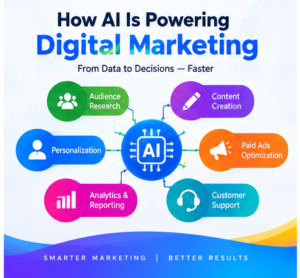
Data is one of the foundations of modern marketing. As AI systems become more capable, the quality and organization of business data will become increasingly important.
Businesses should maintain clean customer databases, accurate conversion tracking, properly configured analytics, and reliable campaign reporting. Poor-quality data can lead to poor recommendations and ineffective decisions.
Companies should also establish clear rules around customer privacy and data usage. Transparency can help build trust while reducing unnecessary risks.
Creativity Will Still Matter
One misconception about AI is that marketing will become completely automated. In reality, creativity can become even more valuable.
When technology handles repetitive activities, marketers can spend more time developing original concepts, understanding audiences, creating stronger brand identities, and finding new ways to communicate.
A successful campaign still needs a compelling idea. It needs a message that people understand and remember. It needs a reason for customers to care about the product or service.
Technology can support that process, but human creativity remains a major part of effective communication.
The Next Stage of Digital Marketing

The next stage of digital marketing will likely be more automated, personalized, predictive, and data-driven. Marketing platforms will continue becoming smarter, while businesses will have access to increasingly powerful tools.
However, technology alone will not determine success. Businesses that combine intelligent automation with strong strategy, useful content, responsible data practices, and genuine customer understanding will be better positioned to adapt to change.
The most important lesson is simple: businesses should not adopt AI merely because it is trending. They should adopt it when it solves a real problem, improves efficiency, enhances customer experience, or creates measurable business value.
The marketers who learn how to combine technology with creativity and strategic thinking will be able to build more efficient workflows while maintaining the human connection that makes brands memorable.
Artificial intelligence is changing the tools available to marketers, but the purpose of marketing remains the same: understand people, communicate value, build relationships, and create meaningful business outcomes. The companies that keep this principle at the center of their strategy can use technological innovation as a powerful extension of their marketing capabilities rather than treating it as a replacement for human expertise.
Final Thoughts
Ai in Digital Marketing is changing how businesses research audiences, create content, personalize experiences, manage advertising, analyze data, and communicate with customers.
The biggest opportunity is not simply doing more work with AI. It is using technology to remove repetitive tasks and create more time for strategy, creativity, customer understanding, and innovation.
Businesses should approach AI with realistic expectations. Start with specific problems, protect customer data, review AI-generated outputs, measure results, and keep humans involved in important decisions.
Ultimately, Ai in Digital Marketing is becoming a core capability for modern teams that want to work efficiently in a data-rich environment.
Pingback: AI Content: Avoid Common AI Writing Mistakes That Hurt Your Brand 2026