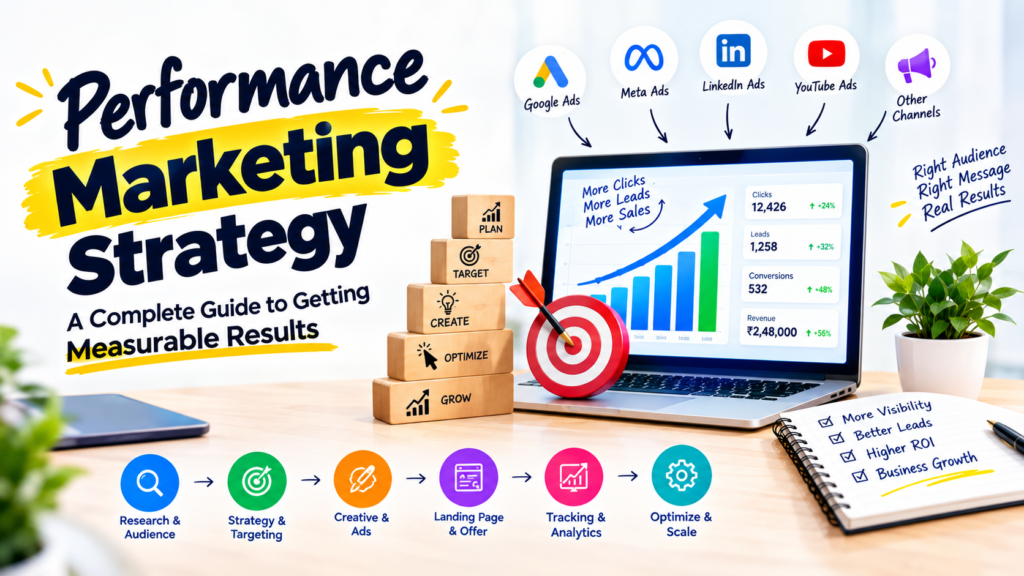
Performance Marketing Strategy: A Complete Guide to Getting Measurable Results
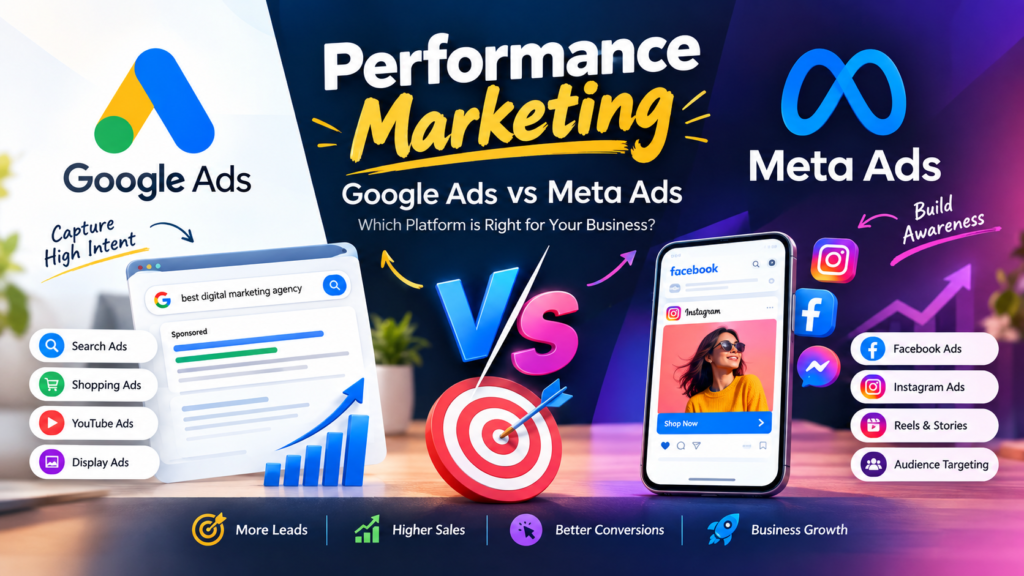
A Performance Marketing Strategy helps businesses focus on measurable marketing outcomes instead of simply spending money on advertising and hoping for results. Unlike traditional marketing approaches where measuring the direct impact of every campaign can be difficult, performance-focused campaigns are built around measurable actions such as clicks, leads, registrations, purchases, bookings, or revenue. A successful Performance Marketing Strategy connects advertising, audience targeting, creative content, landing pages, conversion tracking, and optimization into one complete system. The goal is not simply to generate traffic. The goal is to attract the right audience and encourage them to take valuable actions. What Is Performance Marketing? Performance marketing is a digital marketing approach where campaigns are evaluated based on measurable outcomes. These outcomes can include: Website visits Leads Sales App installations Registrations Calls Bookings Subscriptions Revenue A Performance Marketing Strategy uses these measurable objectives to determine where advertising budget should be allocated. For example, an ecommerce business may focus on purchases and return on ad spend, while a service business may focus on qualified leads and cost per lead. Why Performance Marketing Matters Businesses today have access to multiple advertising platforms and channels. However, simply running advertisements does not guarantee success. Companies need to understand: Who they are targeting What message they are communicating Which platform they are using Where users are being sent What action they want users to take How results are being measured How campaigns will be optimized A strong Performance Marketing Strategy brings these elements together. It creates a structured approach where every major marketing decision can be connected to a measurable business objective. Performance Marketing vs Traditional Marketing Traditional advertising often focuses on visibility and reach. Performance marketing adds another layer: measurable action. For example, a billboard can generate awareness, but accurately connecting one individual purchase to that billboard may be difficult. A digital advertising campaign can track clicks, conversions, costs, and other measurable signals. This does not mean traditional marketing has no value. Different businesses can use different channels depending on their objectives. However, businesses looking for measurable digital acquisition can benefit from a structured Performance Marketing Strategy. Key Components of a Performance Marketing Strategy 1. Define Your Business Objective The first step is defining what you want the campaign to achieve. Possible objectives include: Generate leads Increase ecommerce sales Get more bookings Generate phone calls Increase subscriptions Promote an application Generate qualified enquiries Your objective determines how the campaign should be designed. For example, if your objective is lead generation, optimizing only for clicks may not be enough. You need to understand whether those clicks are actually turning into qualified leads. 2. Understand Your Target Audience Audience research is one of the most important parts of a Performance Marketing Strategy. You need to understand: Age groups Location Interests Problems Buying behavior Search behavior Pain points Purchase motivation Objections For example, a premium wedding photography business may target couples who are actively planning weddings rather than simply targeting everyone interested in photography. Better audience understanding can improve messaging, targeting, creative development, and landing pages. 3. Understand Search and Purchase Intent Not every person has the same level of buying intent. Someone searching: “What is performance marketing?” is probably looking for information. Someone searching: “Performance marketing agency near me” may have stronger commercial intent. Someone searching: “Hire performance marketing agency” may be even closer to taking action. A good Performance Marketing Strategy considers these differences when deciding which audiences and keywords to target. Choosing the Right Advertising Platform Different platforms can serve different purposes. Google Ads Google Ads can help businesses reach users actively searching for products or services. Search campaigns can be particularly useful when there is existing demand. Businesses can target relevant keywords and send users to specific landing pages. Meta Ads Meta advertising can help businesses reach audiences based on interests, behaviors, demographics, engagement, and other available targeting signals. It can be useful for discovery, visual storytelling, lead generation, ecommerce, remarketing, and promotional campaigns. LinkedIn Ads LinkedIn can be relevant for B2B campaigns where professional characteristics are important to the targeting strategy. Businesses can reach specific professional audiences depending on campaign objectives and available targeting options. YouTube Advertising Video advertising can help businesses communicate complex products, demonstrate services, educate audiences, and build awareness. The right platform depends on your audience, offer, creative assets, funnel, and business objective. Creating the Right Offer Advertising can bring people to your business, but the offer determines what happens next. An offer could be: Free consultation Discount Demo Free trial Downloadable guide Product bundle Limited promotion Free audit Appointment A Performance Marketing Strategy should make the offer relevant to the audience and campaign stage. A cold audience may respond better to educational value, while a high-intent audience may be more interested in a direct purchase or consultation. Creating High-Converting Ad Creative Your advertisement needs to communicate value quickly. Strong creative generally answers three questions: What is the problem? What is the solution? Why should the user care? For example: Problem: Getting leads but struggling to convert them? Solution: Build a data-driven acquisition system. Action: Book a strategy consultation. Different creative formats can be tested, including: Static images Carousels Short videos Reels Testimonials Product demonstrations UGC-style creatives Educational videos Creative testing is a major part of a Performance Marketing Strategy because audience response can change over time. Landing Pages Matter Sending paid traffic to a poorly designed landing page can waste advertising budget. The landing page should match the advertisement. If an advertisement promotes “Google Ads Management,” the landing page should clearly explain Google Ads management rather than forcing users to search through a generic homepage. A strong landing page may include: Clear headline Strong value proposition Benefits Social proof Testimonials Case studies FAQs Relevant visuals Clear CTA Simple form The landing page should make the next action obvious. Conversion Tracking Without reliable tracking, optimization becomes difficult. Businesses should track the actions that matter. Depending on the business, these might include: Form submissions Purchases Calls Bookings Sign-ups Downloads Add-to-cart events Checkout events
Performance Marketing Strategy: A Complete Guide to Getting Measurable Results Read More »