Digital marketing has become one of the most important ways for businesses to reach customers, build their brand, generate leads, and increase revenue. Whether you are running a small local business, an e-commerce store, a startup, or an established company, having a strong online marketing strategy is no longer optional.
This Digital Marketing Guide will help you understand what digital marketing is, how it works, the different types of digital marketing, why businesses need it, and how you can create an effective strategy in 2026.
The digital landscape is constantly changing. Search engines are becoming smarter, social media platforms are evolving, artificial intelligence is transforming marketing workflows, and customers are expecting more personalized experiences. This makes it important for businesses to understand the fundamentals before investing in different marketing channels.
If you are looking for a practical Digital Marketing Guide that explains everything from SEO and social media to performance marketing, content marketing, email marketing, and analytics, you are in the right place.
What Is Digital Marketing?

Digital marketing refers to the promotion of products, services, brands, or businesses through digital channels and technologies.
These channels can include:
- Search engines
- Social media platforms
- Websites
- Online advertising
- Video platforms
- Mobile applications
- Content platforms
- Online marketplaces
Unlike traditional marketing, digital marketing allows businesses to reach specific audiences, measure campaign performance, analyze customer behavior, and optimize marketing activities based on data.
A good Digital Marketing Guide should not focus only on advertising. Digital marketing covers the complete customer journey—from discovering a brand to researching a product, making a purchase, and eventually becoming a repeat customer.
For example, someone might discover a company through Google, visit its website, follow the brand on Instagram, watch one of its videos, click a Google advertisement, and eventually become a customer.
That entire journey can involve multiple digital marketing channels working together.
Why Is Digital Marketing Important for Businesses?
One of the biggest advantages of digital marketing is its ability to connect businesses with highly relevant audiences.
Traditional advertising often reaches a broad audience, while digital marketing allows businesses to target people based on factors such as interests, demographics, location, search behavior, and online activity.
According to this Digital Marketing Guide, some of the biggest benefits include:
1. Reach a Larger Audience
The internet allows businesses to reach customers beyond their local geographical area. A small business can potentially attract customers from different cities, states, or even countries.
2. Target the Right Customers
Platforms such as Google and Meta provide advertising tools that allow businesses to target specific audience segments.
3. Measure Results
Digital campaigns can be tracked using metrics such as impressions, clicks, conversions, cost per lead, return on ad spend, and website traffic.
4. Build Brand Awareness
Consistent content across search engines and social media can help businesses establish a recognizable online presence.
5. Generate Leads
Digital marketing can help businesses attract potential customers through websites, landing pages, forms, advertisements, social media, and other channels.
6. Increase Sales
A properly planned digital marketing strategy can move potential customers through the buying journey and ultimately increase conversions.
7. Improve Customer Relationships
Businesses can communicate directly with customers through social media, email, messaging platforms, and content.
Types of Digital Marketing
A complete Digital Marketing Guide should cover the major areas of digital marketing because each channel serves a different purpose.
Here are the most important types of digital marketing businesses should understand.
1. Search Engine Optimization (SEO)
Search Engine Optimization, commonly known as SEO, is the process of improving a website so that it can appear more prominently in search engine results.
For example, if someone searches for:
“digital marketing agency near me”
businesses that have optimized their websites may have an opportunity to appear in the search results.
SEO generally includes:
- Keyword research
- On-page SEO
- Technical SEO
- Content optimization
- Internal linking
- Website performance
- Backlink building
- Local SEO
SEO is particularly valuable because it can generate organic traffic without paying for every individual click.
A strong Digital Marketing Guide must include SEO because search engines remain an important discovery channel for businesses.
2. Social Media Marketing
Social media marketing involves promoting a business through platforms such as Instagram, Facebook, LinkedIn, YouTube, TikTok, and other relevant networks.
Businesses use social media to:
- Build brand awareness
- Publish content
- Engage with audiences
- Generate leads
- Promote products
- Share educational content
- Build communities
- Drive website traffic
Social media is not simply about posting frequently. Successful social media marketing requires a clear strategy, consistent branding, valuable content, audience understanding, and performance analysis.
For many businesses, social media becomes an important part of their overall Digital Marketing Guide because it combines branding, communication, content, and lead generation.
3. Performance Marketing
Performance marketing focuses on measurable actions and results.
These actions may include:
- Website visits
- Leads
- App installations
- Purchases
- Registrations
- Phone calls
- Form submissions
Common performance marketing channels include Google Ads, Meta Ads, display advertising, shopping campaigns, and other paid digital advertising platforms.
One of the biggest advantages of performance marketing is that businesses can monitor campaign performance and make adjustments based on data.
For example, if one advertising campaign generates leads at a lower cost than another, marketers can analyze the results and adjust their budgets and targeting accordingly.
This is why performance marketing deserves an important place in any modern Digital Marketing Guide.
4. Content Marketing
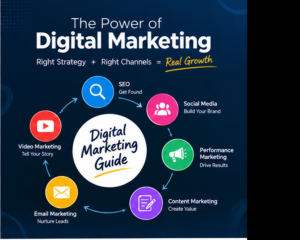
Content marketing involves creating and distributing valuable content to attract and engage a target audience.
Examples include:
- Blog posts
- Videos
- Infographics
- Guides
- Case studies
- E-books
- Social media posts
- Podcasts
- Tutorials
Instead of directly promoting a product in every piece of content, content marketing focuses on answering questions, solving problems, educating customers, and building trust.
For example, a digital marketing agency could publish an article explaining how businesses can improve their online presence.
This content can attract people who are actively searching for marketing information and potentially turn them into future customers.
5. Email Marketing
Email marketing allows businesses to communicate directly with people who have subscribed to their email lists.
Businesses can use email marketing for:
- Newsletters
- Promotions
- Product announcements
- Educational content
- Lead nurturing
- Customer retention
- Event invitations
Email marketing can be particularly useful for maintaining relationships with existing leads and customers.
A complete Digital Marketing Guide should not overlook email because owned communication channels can play an important role in customer retention.
6. Influencer Marketing
Influencer marketing involves collaborating with individuals who have an established audience on social media or other online platforms.
Depending on the business, influencers can help with:
- Brand awareness
- Product discovery
- Social proof
- Content creation
- Audience engagement
However, businesses should select influencers based on audience relevance and authenticity rather than simply looking at follower counts.
7. Video Marketing
Video has become a major part of modern digital communication.
Businesses can use videos for:
- Product demonstrations
- Tutorials
- Brand storytelling
- Customer testimonials
- Educational content
- Short-form social media content
- Advertisements
Platforms such as YouTube, Instagram, and other video-focused platforms provide opportunities for businesses to distribute video content to large audiences.
Video marketing is therefore another important component of this Digital Marketing Guide.
How Does Digital Marketing Work?
Digital marketing generally works by moving people through different stages of the customer journey.
A simplified customer journey looks like this:
Awareness → Interest → Consideration → Conversion → Retention
Awareness
The customer discovers your business through search engines, social media, advertising, content, or other channels.
Interest
The customer begins learning more about your business and what you offer.
Consideration
The customer compares your products, services, prices, reviews, and competitors.
Conversion
The customer takes an action such as purchasing a product, booking a service, submitting a form, or contacting your business.
Retention
The business continues communicating with the customer to encourage repeat purchases and long-term relationships.
Understanding this journey is one of the fundamental concepts explained in any effective Digital Marketing Guide.
How to Create a Digital Marketing Strategy
Having different marketing channels is not enough. Businesses need a strategy that connects their activities with measurable objectives.
Here is a simple framework you can follow.
Step 1: Define Your Business Goals
Start by deciding what you want your marketing to achieve.
Your goals could include:
- Increasing website traffic
- Generating leads
- Increasing sales
- Building brand awareness
- Growing social media
- Improving customer retention
Your marketing strategy should support your larger business objectives.
Step 2: Identify Your Target Audience
Understand who your ideal customers are.
Consider:
- Age
- Location
- Interests
- Problems
- Needs
- Buying behavior
- Budget
- Search behavior
The better you understand your audience, the easier it becomes to create relevant marketing campaigns.
Step 3: Research Your Competitors

Analyze what competitors are doing online.
Look at:
- Their websites
- SEO strategy
- Social media
- Content
- Advertisements
- Offers
- Branding
- Customer reviews
Competitor research can help you identify opportunities and gaps in the market.
Step 4: Choose the Right Marketing Channels
You do not necessarily need to use every platform.
Instead, choose channels based on your audience and goals.
For example:
SEO → Long-term organic visibility
Google Ads → Search-based demand and immediate traffic
Social Media → Brand awareness and community
Meta Ads → Audience targeting and paid campaigns
Email Marketing → Lead nurturing and retention
Content Marketing → Education and organic growth
Choosing the right combination of channels is a key principle of this Digital Marketing Guide.
Step 5: Create Valuable Content
Content should provide a reason for people to engage with your brand.
Instead of creating content simply to fill your social media calendar, ask:
“Does this content help, educate, entertain, or solve a problem for my audience?”
If the answer is yes, the content has a stronger chance of generating meaningful engagement.
Step 6: Launch Your Campaigns
Once your strategy, content, targeting, and tracking systems are ready, launch your campaigns.
Start with realistic budgets and monitor performance carefully.
Avoid making major decisions based on a very small amount of data.
Step 7: Measure and Optimize
Digital marketing is not a “set it and forget it” process.
You should regularly analyze performance and identify:
- What is working?
- What is underperforming?
- Which audience segments convert?
- Which content receives engagement?
- Which campaigns generate leads?
- Which channels produce revenue?
Optimization is one of the biggest differences between simply doing Digital Marketing Guideand managing it strategically.
Important Digital Marketing Metrics
One of the most valuable lessons in this Digital Marketing Guide is that businesses should measure outcomes rather than focusing only on vanity metrics.
Important metrics include:
Website Traffic
Shows how many visitors are coming to your website.
Click-Through Rate (CTR)
Measures how frequently people click an advertisement, search result, or other clickable element.
Conversion Rate
Shows the percentage of visitors who complete a desired action.
Cost Per Click (CPC)
Measures the average amount paid for each advertising click.
Cost Per Lead (CPL)
Measures how much it costs to generate a lead.
Return on Ad Spend (ROAS)
Helps businesses evaluate revenue generated relative to advertising spend.
Customer Acquisition Cost (CAC)
Measures the cost associated with acquiring a new customer.
Customer Lifetime Value (CLV)
Estimates the value a customer can generate throughout their relationship with a business.
Digital Marketing Trends to Watch in 2026
The marketing industry continues to evolve rapidly. Businesses should pay attention to several major developments.
Artificial Intelligence
AI is becoming increasingly integrated into content creation, customer analysis, automation, advertising, personalization, and marketing workflows.
However, businesses should use AI strategically rather than relying on automatically generated content without human review.
Personalization
Customers increasingly expect relevant experiences. Businesses can use customer data and behavioral insights to deliver more personalized messaging.
Short-Form Video
Short-form video continues to play an important role in social media marketing and brand discovery.
First-Party Data
Businesses are placing greater importance on information collected directly from their customers through websites, forms, subscriptions, purchases, and other interactions.
Marketing Automation
Automation can help businesses manage repetitive activities such as email sequences, lead nurturing, reporting, and customer communication.
Search Evolution
Search is evolving beyond traditional keyword-based results. Businesses need to create genuinely useful, well-structured content that answers user questions and demonstrates expertise.
These trends make updating your Digital Marketing Guide regularly important because digital marketing is an evolving field rather than a fixed system.
How Much Does Digital Marketing Cost?
There is no single price for digital marketing.
The cost depends on factors such as:
- Business size
- Industry
- Marketing goals
- Geographic market
- Advertising budget
- Number of services
- Competition
- Content requirements
- Campaign complexity
A business might invest in SEO, social media management, paid advertising, content creation, website development, or a combination of several services.
The important thing is to connect spending with measurable business objectives.
Instead of asking only:
“How much does digital marketing cost?”
businesses should also ask:
“What business outcome are we trying to achieve with this investment?”
Common Digital Marketing Mistakes
Even Digital Marketing Guide investing significant money into digital marketing can make strategic mistakes.
Some common problems include:
Targeting Everyone
Trying to reach everyone can make marketing messages too generic.
Ignoring SEO
Businesses sometimes focus entirely on paid advertising while ignoring long-term organic visibility.
Posting Without a Strategy
Random social media posts rarely create a consistent customer journey.
Not Tracking Conversions
Without conversion tracking, it becomes difficult to understand which marketing activities are actually generating results.
Focusing Only on Followers
A large follower count does not automatically translate into customers or revenue.
Ignoring the Website
Your website is often the destination where Digital Marketing Guide traffic turns into leads or customers.
Expecting Instant Results
Some marketing channels, especially SEO and content marketing, require consistent effort and time.
Avoiding these mistakes can make your overall Digital Marketing Guide strategy significantly more effective.
Digital Marketing vs Traditional Marketing
Traditional marketing includes channels such as:
- Television
- Radio
- Newspapers
- Billboards
- Print advertising
- Direct mail
Digital marketing includes:
- Search engines
- Websites
- Social media
- Online advertising
- Content
- Video
The major difference is that digital channels generally provide more opportunities for detailed targeting, tracking, optimization, and interaction.
That does not mean traditional marketing is irrelevant. The right approach depends on the business, audience, objectives, and available resources.
A modern Digital Marketing Guide should therefore focus on selecting the right marketing mix rather than assuming one channel works for every business.
Why Small Businesses Need Digital Marketing
Digital Marketing Guide is not only for large corporations.
Small businesses can use digital marketing to compete for attention in specific markets and reach customers more efficiently.
For example, a local business can use:
- Local SEO
- Google Business Profile
- Social media
- Paid advertising
- Customer reviews
- Content marketing
- Email marketing
A small business can also build a strong niche presence by consistently creating useful content and communicating its unique value.
This is why digital marketing has become an important growth tool for businesses of different sizes.
The Future of Digital Marketing Guide
The future of marketing will likely involve an even stronger combination of technology, creativity, data, and human strategy.
Artificial intelligence will continue changing marketing workflows, while customer expectations will continue evolving.
However, the fundamentals will remain important:
Understand your audience.
Create value.
Build trust.
Reach people through the right channels.
Digital Marketing Guide
Measure your results.
Continuously improve.
Digital Marketing Guide Technology can make marketing faster and more scalable, but businesses still need strong positioning, compelling offers, creative ideas, and meaningful customer experiences.
That is an important principle to remember when using this Digital Marketing Guide to build a long-term strategy.
Frequently Asked Questions About Digital Marketing
What is digital marketing?
Digital Marketing Guide is the promotion of businesses, products, and services through online channels such as search engines, websites, social media, email, content platforms, and digital advertising.
Why is digital marketing important?
Digital marketing helps businesses reach targeted audiences, build awareness, generate leads, communicate with customers, and measure marketing performance.
What are the main types of digital marketing?
The major types in Digital Marketing Guide include SEO, social media marketing, performance marketing, content marketing, email marketing, influencer marketing, video marketing, and online advertising.
Is digital marketing suitable for small businesses?
Yes. Small businesses can use digital marketing to reach specific audiences, increase local visibility, generate leads, and compete within their target markets.
How long does digital marketing take to produce results?
The timeframe varies by channel and objective. Paid advertising can produce traffic quickly, while SEO and content marketing generally require consistent effort over a longer period.
Is SEO better than paid advertising?
SEO and paid advertising serve different purposes. SEO can support long-term organic visibility, while paid advertising can provide more immediate traffic and targeted campaigns. The right combination depends on the business.
Can AI replace digital marketers?
AI can automate and support many marketing tasks,Digital Marketing Guide but strategy, creativity, brand positioning, customer understanding, and decision-making still require human involvement.
How do I start digital marketing for my business?
Start by defining your goals, understanding your audience, researching competitors, selecting appropriate channels, creating valuable content, setting up tracking, launching campaigns, and continuously optimizing performance.
Final Thoughts
Digital marketing is no longer simply about running advertisements or posting on social media. It is a complete ecosystem that connects businesses with customers through search, content, social media, websites, advertising, email, video, and data.
The most important takeaway from this Digital Marketing Guide is that successful marketing starts with strategy.
You do not need to be everywhere.
You need to be where your customers are.
You need to Digital Marketing Guide understand what they need, create valuable experiences, communicate your value clearly, and measure whether your marketing activities are producing meaningful business results.
Whether you are a startup, local business, personal brand, e-commerce company, or established organization, the right digital marketing strategy can help you build visibility, generate opportunities, and create sustainable growth.
As technology continues to evolve in 2026 and beyond, businesses that combine data, creativity, technology, and customer-focused thinking will be better positioned to adapt to the changing digital landscape.
Use this Digital Marketing Guide as your foundation, but remember that digital marketing is an ongoing process. Test different strategies, learn from your data, understand your customers, and keep improving.
Your next step is simple: define your marketing goal, identify your audience, choose the right channels, and start building your digital presence.
Pingback: Ai in Digital Marketing: Avoid Costly AI Marketing Mistakes 2026
Pingback: Small Business Growth: Proven Digital Marketing Strategies 2026
Pingback: Social Media Marketing: Avoid Common Mistakes That Hurt Your Growth 2026