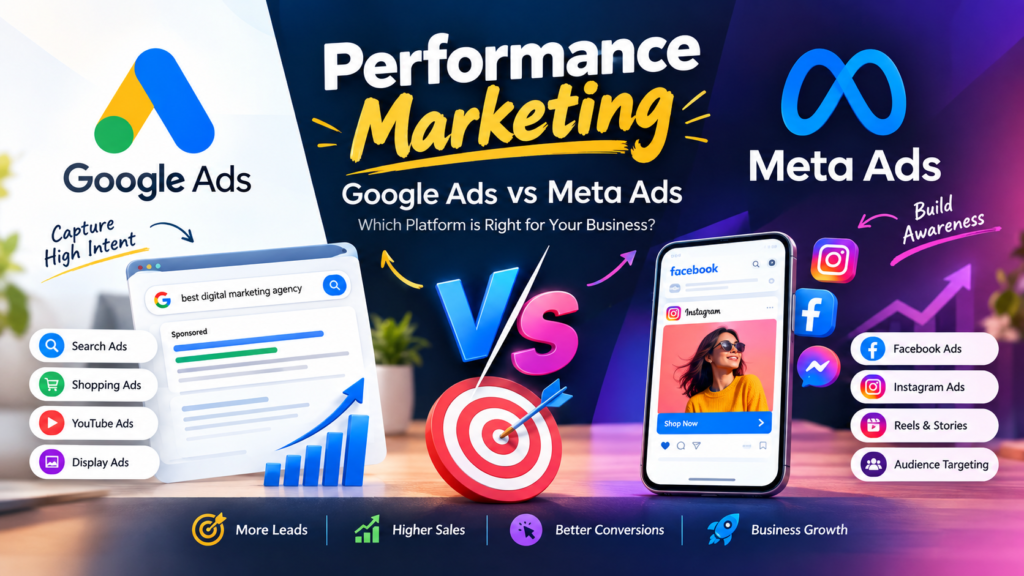
When businesses want faster online growth, two advertising platforms often come into the conversation: Google Ads and Meta Ads. Both platforms can help businesses reach potential customers, generate leads, increase sales, and build brand awareness. However, they work in very different ways.
Choosing between them is not simply about asking which platform is better. The right choice depends on your business model, target audience, customer journey, budget, goals, and the type of demand you are trying to capture.
A strong performance marketing strategy starts with understanding how each platform works and what role it can play in the customer journey.
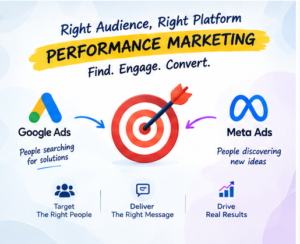
Google Ads is primarily built around search intent. People often use Google when they already have a problem, need, or product in mind. Meta Ads, which includes platforms such as Facebook and Instagram, is largely built around audience targeting, discovery, interests, and engagement.
This makes both platforms valuable but in different situations.
In this complete guide, we will compare Google Ads vs Meta Ads, understand their differences, explore their advantages and limitations, discuss costs and targeting, and explain how businesses can choose the right platform.
What Is Performance Marketing ?
Before comparing Google Ads and Meta Ads, it is important to understand the concept of performance marketing.
Performance marketing is a digital advertising approach where campaigns are measured according to specific actions and outcomes.
These outcomes can include:
- Website visits
- Leads
- Purchases
- App installations
- Phone calls
- Form submissions
- Registrations
- Bookings
- Revenue
The key idea behind performance marketing is measurement.
Instead of simply asking whether people saw an advertisement, marketers look at what happened after people interacted with it.
For example, imagine a business spends ₹50,000 on advertising and generates 100 qualified leads. The business can analyze the campaign to understand its cost per lead, conversion rate, and eventual revenue.
This data can then be used to optimize future campaigns.
That measurable approach makes performance marketing particularly useful for businesses that want to connect advertising investment with specific business outcomes.
Google Ads vs Meta Ads: The Basic Difference
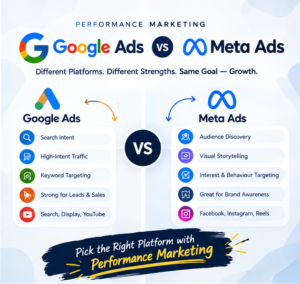
The simplest way to understand the difference is:
Google Ads captures existing demand.
Meta Ads helps create and stimulate demand.
For example, someone searches:
“best digital marketing agency in Delhi”
That person is actively looking for a solution. Google Ads can place a relevant advertisement in front of that person.
On the other hand, someone scrolling through Instagram may see an advertisement for a digital marketing agency even though they were not actively searching for one.
The advertisement can create interest and introduce the business to them.
This distinction is extremely important when planning performance marketing campaigns.
What Are Google Ads?
Google Ads is Google’s online advertising platform.
Businesses can use Google Ads to promote their products and services across Google’s advertising ecosystem.
Some common Google advertising formats include:
- Search Ads
- Display Ads
- Shopping Ads
- YouTube Ads
- App campaigns
- Local-focused advertising
- Performance-oriented automated campaigns
Google Search Ads are particularly useful when customers are actively searching for products or services.
For example, a web development company might target keywords such as:
- web development company
- website development services
- ecommerce website developer
- professional website designer
When users search for these terms, relevant advertisements can appear.
This makes Google Ads an important channel for intent-driven performance marketing.
What Are Meta Ads?
Meta Ads are advertisements delivered across Meta’s ecosystem, including platforms such as Facebook and Instagram.
Meta advertising allows businesses to reach people based on audience characteristics and behavioral signals.
Businesses can use Meta Ads for:
- Brand awareness
- Lead generation
- Website traffic
- Sales
- Engagement
- App promotion
- Retargeting
- Product discovery
Meta is especially powerful for visual advertising.
Businesses can use:
- Images
- Videos
- Reels
- Carousels
- Stories
- Collection-style experiences
- Lead forms
Because users are generally browsing rather than actively searching for a solution, creative quality plays an important role in Meta-based performance marketing.
Google Ads vs Meta Ads: Intent vs Discovery
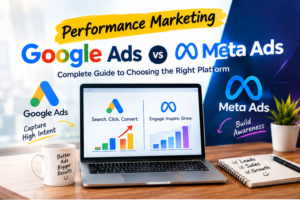
One of the biggest differences between Google Ads and Meta Ads is user intent.
Google generally captures people when they are searching for something.
Meta generally reaches people while they are browsing content.
Consider two examples.
Example 1: Google
A person searches:
“buy running shoes online”
They already have purchase intent.
A running shoe company can use Google Ads to appear when that search happens.
Example 2: Meta
A person is scrolling through Instagram and sees an attractive video showing a new running shoe.
They may not have been planning to purchase shoes at that moment.
The advertisement creates curiosity.
This is why performance marketing campaigns on Google and Meta can produce very different customer journeys.
Google Ads Advantages
Google Ads offers several advantages for businesses.
1. High Search Intent
One of Google’s biggest strengths is search intent.
Users actively type queries into Google, which provides valuable information about what they are looking for.
2. Faster Visibility
Businesses can appear near the top of search results without waiting months for organic rankings.
3. Strong Lead Generation
Service businesses can use search campaigns to capture people actively looking for specific services.
4. Keyword-Based Targeting
Advertisers can build campaigns around relevant search terms.
5. Multiple Advertising Formats
Google provides advertising opportunities across search, video, shopping, display, and other placements.
These characteristics make Google particularly useful for intent-driven performance marketing.
Meta Ads Advantages
Meta Ads also provides several major benefits.
1. Powerful Audience Targeting
Meta’s advertising ecosystem provides sophisticated options for reaching specific audiences.
2. Strong Visual Advertising
Businesses can use videos, images, carousels, and other creative formats.
3. Excellent Brand Discovery
Meta can introduce products and services to audiences that may not yet know about a business.
4. Retargeting Opportunities
Businesses can reconnect with people who have previously interacted with their websites, content, or brand.
5. Social Environment
Users are already engaging with content, creators, communities, and brands.
These advantages make Meta a valuable platform for creative and audience-driven performance marketing.
Google Ads vs Meta Ads: Targeting
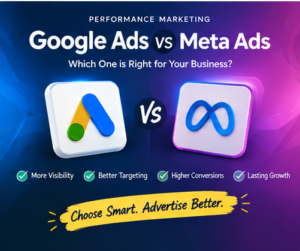
Targeting works differently on both platforms.
Google Ads often uses signals connected to:
- Search queries
- Keywords
- Location
- Device
- Audience signals
- Search behavior
- Customer data
Meta Ads can use signals connected to:
- Demographics
- Interests
- Behaviors
- Engagement
- Customer lists
- Website activity
- Platform interactions
For performance marketing, the important question is not simply which platform has more targeting options.
The more important question is:
Which platform can reach your ideal customer at the right stage of the buying journey?
Google Ads vs Meta Ads: Cost
Advertising costs vary significantly depending on the industry, competition, location, audience, campaign objective, creative quality, landing page, and many other factors.
Google Ads can become expensive for highly competitive commercial keywords because businesses may compete for the same searches.
For example, industries such as:
- Insurance
- Finance
- Legal services
- Real estate
- Healthcare
- B2B services
can have competitive search advertising environments.
Meta Ads can have different cost dynamics because the platform operates primarily through audience and ad-auction signals rather than traditional keyword bidding.
This means businesses should evaluate cost using actual campaign outcomes rather than assuming one platform is always cheaper.
A mature performance marketing strategy looks beyond CPC and considers metrics such as cost per qualified lead, conversion rate, customer acquisition cost, and revenue.
CPC vs CPL vs CPA vs ROAS
Understanding advertising metrics is essential for successful campaigns.
CPC — Cost Per Click
CPC tells you how much you are paying, on average, for a click.
CPL — Cost Per Lead
CPL tells you how much it costs to generate a lead.
CPA — Cost Per Acquisition
CPA measures the cost of acquiring a desired customer or conversion.
ROAS — Return on Ad Spend
ROAS compares advertising revenue with advertising expenditure.
For example, if you spend ₹10,000 and generate ₹40,000 in tracked revenue, your ROAS is 4x.
These metrics are important because performance marketing should ultimately focus on meaningful business outcomes rather than clicks alone.
Which Businesses Should Use Google Ads?
Google Ads can be particularly useful for businesses where customers actively search for products or services.
Examples include:
Local Services
- Plumbers
- Dentists
- Lawyers
- Salons
- Restaurants
- Repair services
- Marketing agencies
Professional Services
- Consulting
- Accounting
- Legal services
- Web development
- Marketing services
E-commerce
Businesses selling products online can use search, shopping, and other Google advertising formats.
High-Intent Products
If customers typically research a product before buying it, Google can be useful.
For these businesses, performance marketing through Google can focus on capturing existing demand.
Which Businesses Should Use Meta Ads?
Meta Ads can be particularly useful when visual content and audience discovery are important.
Examples include:
- Fashion brands
- Beauty brands
- Fitness businesses
- Restaurants
- Events
- Lifestyle products
- E-commerce brands
- Personal brands
- Coaches
- Creators
Meta can also be useful when businesses need to introduce a product to potential customers before those customers actively search for it.
This makes Meta a strong channel for awareness-driven performance marketing.
Google Ads vs Meta Ads for Lead Generation
Both platforms can generate leads, but the lead-generation process can be different.
Google can capture users who are already searching for a solution.
Meta can generate leads through advertisements and native lead forms while users are browsing social content.
For example, a digital marketing agency could target someone searching for:
“performance marketing agency near me.”
That user has demonstrated search intent.
The same agency could run an Instagram campaign showing a case study and inviting business owners to request a free consultation.
Both campaigns can generate leads, but the audience mindset is different.
This is why performance marketing campaigns should be designed around customer intent rather than simply copying the same campaign across platforms.
Google Ads vs Meta Ads for E-commerce
E-commerce businesses can potentially benefit from both platforms.
Google can help capture product-related searches and shopping intent.
Meta can help businesses showcase products through visual content and reach new audiences.
For example, a fashion brand could use Google to capture searches for specific products while using Instagram advertising to introduce new collections.
Using both platforms can create a broader performance marketing ecosystem.
Google can help capture demand while Meta can help generate discovery and consideration.
Google Ads vs Meta Ads for Brand Awareness
If your primary goal is brand awareness, Meta can provide strong opportunities through visual and social content.
Businesses can use:
- Reels
- Stories
- Videos
- Carousel advertisements
- Influencer-style creative
- Lifestyle imagery
Google also has awareness-oriented advertising options through its wider advertising ecosystem, including YouTube and display placements.
The right approach depends on the audience and campaign objective.
Brand awareness can also support future performance marketing campaigns because people who already recognize a brand may be more likely to engage with future advertisements.
Google Ads vs Meta Ads for Retargeting
Retargeting allows businesses to reconnect with people who have previously interacted with them.
For example, someone might visit your website but leave without submitting a form.
A retargeting campaign can remind that person about your business.
Retargeting can be useful on both Google and Meta.
The exact setup depends on the platform, tracking implementation, audience eligibility, privacy requirements, and campaign objectives.
Retargeting is often an important component of performance marketing because it can help businesses continue conversations with people who have already demonstrated interest.
Creative Strategy: Google Ads vs Meta Ads
Creative requirements differ between the two platforms.
Google Search Ads depend heavily on:
- Headlines
- Descriptions
- Keywords
- Offers
- Landing pages
- Search intent
Meta Ads depend heavily on:
- Images
- Videos
- Hooks
- Headlines
- Visual storytelling
- Offers
- Calls to action
A successful performance marketing campaign should therefore create platform-specific advertisements rather than simply uploading the same creative everywhere.
Landing Pages Matter
A great advertisement cannot compensate for a poor landing page.
Imagine you spend money attracting users to your website, but the page:
- Loads slowly
- Has confusing messaging
- Has no clear CTA
- Looks outdated
- Does not match the advertisement
- Makes the user search for contact information
Your advertising performance can suffer.
A strong landing page should have:
- Clear headline
- Relevant messaging
- Strong CTA
- Trust signals
- Easy navigation
- Mobile-friendly design
- Relevant information
- Fast loading experience
Landing page optimization is therefore a crucial part of performance marketing.
Google Ads vs Meta Ads: Funnel Strategy
Instead of viewing Google and Meta as competitors, businesses can use them at different stages of the funnel.
Top of Funnel
Use content and advertising to introduce your brand.
Meta can be useful for discovery.
Middle of Funnel
Educate potential customers using:
- Videos
- Case studies
- Guides
- Testimonials
- Educational content
Bottom of Funnel
Capture users who are ready to convert.
Google Search can be particularly useful when users are actively looking for a solution.
A complete performance marketing funnel can therefore combine multiple platforms instead of depending on only one.
Should You Use Google Ads or Meta Ads?
The answer depends on your business.
Choose Google when:
- People actively search for your product
- Search intent is strong
- You provide local services
- You want to capture existing demand
- Your keywords have commercial intent
Consider Meta when:
- Your product is highly visual
- Social discovery matters
- You want to build awareness
- You have strong creative content
- You want to reach audiences before they search
Consider using both when your customer journey involves both discovery and active search.
A balanced performance marketing strategy can use each platform according to its strengths.
When Should You Use Both Google Ads and Meta Ads?
Using both platforms can make sense when your business has enough budget, tracking infrastructure, creative resources, and customer demand to support multiple channels.
For example:
Meta Ads → Awareness
↓
Website → Education
↓
Retargeting → Consideration
↓
Google Search → High Intent
↓
Landing Page → Conversion
↓
CRM/Email → Follow-up
This creates a connected marketing ecosystem.
Instead of treating Google and Meta as separate advertising channels, businesses can use them together within a broader performance marketing strategy.
How to Create a Performance Marketing Strategy
A successful campaign starts before the advertisement is created.
Step 1: Define the Objective
Choose a clear objective.
Examples:
- Leads
- Sales
- Bookings
- App installs
- Revenue
- Qualified inquiries
Step 2: Understand the Customer
Identify:
- Who they are
- What problem they have
- What they want
- What prevents them from buying
- Where they spend time online
Step 3: Select the Platform
Choose Google, Meta, or both according to customer behavior.
Step 4: Build the Offer
Give people a reason to take action.
Your offer might be:
- Free consultation
- Discount
- Demo
- Free audit
- Trial
- Downloadable guide
Step 5: Create the Campaign
Build your audience, creative, messaging, targeting, budget, and conversion setup.
Step 6: Track Results
Measure clicks, leads, conversions, revenue, and other meaningful outcomes.
Step 7: Optimize
Test different:
- Audiences
- Creatives
- Headlines
- Offers
- Landing pages
- Campaign structures
Continuous optimization is one of the core principles of performance marketing.
Common Google Ads Mistakes
Businesses frequently make mistakes when starting Google Ads.
Targeting Broad Keywords Without Strategy
Broad targeting without sufficient control can attract irrelevant traffic.
Sending Everyone to the Homepage
Specific campaigns often benefit from relevant landing pages.
Ignoring Negative Keywords
Irrelevant searches can waste advertising budget.
Not Tracking Conversions
Without proper tracking, it becomes difficult to understand campaign performance.
Focusing Only on Clicks
Clicks do not automatically mean business results.
Avoiding these problems can make your Google-based performance marketing campaigns more efficient.
Common Meta Ads Mistakes
Meta advertising also has common challenges.
Weak Creative
Poor visuals or unclear messaging can reduce engagement.
No Testing
Using one creative indefinitely can limit learning.
Targeting Too Broadly or Too Narrowly
Audience strategy should match campaign objectives and available data.
Weak Offer
Even great targeting cannot compensate for an unappealing offer.
Poor Landing Page
Getting clicks is only part of the customer journey.
These issues can reduce the effectiveness of Meta-based performance marketing campaigns.
How Much Should You Spend on Google Ads and Meta Ads?
There is no universal advertising budget.
Your budget depends on:
- Industry
- Competition
- Customer value
- Geographic market
- Conversion rate
- Business goals
- Sales cycle
- Available cash flow
Instead of choosing a budget simply because competitors are spending a certain amount, businesses should work backward from their objectives.
For example:
Target customers → Required conversions → Required leads → Conversion rate → Required traffic → Advertising budget
This approach makes performance marketing more strategic and measurable.
How to Measure Campaign Success
The most important question is not:
“How many people saw my advertisement?”
It is:
“Did the campaign contribute to my business goal?”
Depending on your business, important metrics may include:
- Qualified leads
- Sales
- Revenue
- Cost per acquisition
- Customer acquisition cost
- Conversion rate
- ROAS
- Lead-to-customer rate
- Average order value
- Customer lifetime value
This is the foundation of effective performance marketing.
Google Ads vs Meta Ads: Quick Comparison
| Factor | Google Ads | Meta Ads |
|---|---|---|
| Primary strength | Search intent | Audience discovery |
| Main platforms | Google ecosystem | Facebook & Instagram |
| User mindset | Searching | Browsing |
| Strong format | Search | Visual/video |
| Best for | Existing demand | Discovery & awareness |
| Keyword targeting | Strong | Limited compared with search |
| Visual storytelling | Moderate to strong depending on format | Very strong |
| Lead generation | Strong | Strong |
| E-commerce | Strong | Strong |
| Retargeting | Yes | Yes |
| Brand discovery | Good | Strong |
| Creative importance | High | Very high |
The comparison shows why there is no universal winner. The appropriate platform depends on your marketing objective and customer behavior.
Google Ads vs Meta Ads for a Digital Marketing Agency
Suppose you operate a digital marketing agency offering:
- SEO
- Social media management
- Performance marketing
- Website development
- Content marketing
Google Ads can help capture businesses actively searching for these services.
Meta Ads can help introduce your agency to business owners who may not currently be searching for an agency.
A combined strategy could therefore create multiple customer entry points.
For agencies, this combination can become a powerful performance marketing approach when supported by strong landing pages, lead qualification, CRM processes, and follow-up systems.
The Role of Data in Performance Marketing
Data is one of the biggest advantages of digital advertising.
Businesses can analyze:
- Audience behavior
- Campaign performance
- Conversion rates
- Advertising costs
- Customer acquisition
- Revenue
- Creative performance
However, collecting data is not enough.
The real value comes from turning data into decisions.
If one campaign generates more qualified leads, you need to understand why.
If one audience produces cheaper conversions, you need to investigate whether those conversions are actually valuable.
This analytical approach is what makes performance marketing different from simply running advertisements.
The Future of Performance Marketing
The future of performance marketing will continue to involve automation, artificial intelligence, first-party data, improved measurement, creative testing, and increasingly sophisticated advertising systems.
AI can help marketers analyze data, generate creative variations, automate repetitive workflows, and identify patterns.
However, businesses still need humans to make strategic decisions.
A successful campaign requires more than technology.
It requires:
- Good positioning
- Strong offers
- Customer understanding
- Creative thinking
- Accurate tracking
- Strategic decision-making
Technology can improve execution, but strategy determines how the technology is used.
Google Ads vs Meta Ads: Final Decision Framework
Before choosing your platform, ask yourself these questions:
1. Are people actively searching for your product?
If yes, Google may be highly relevant.
2. Is your product visually appealing?
If yes, Meta may provide strong opportunities.
3. Do you need to create awareness?
Meta can be useful for discovery and awareness.
4. Do you need high-intent leads?
Google Search can help capture users who are actively looking.
5. Do you have strong creative assets?
If you have high-quality videos, images, and social content, Meta may be attractive.
6. Do you have a strong landing page?
Both platforms benefit from strong post-click experiences.
7. Can you track conversions?
Accurate measurement is essential before scaling campaigns.
These questions can help you build a more focused performance marketing plan.
Conclusion
Google Ads and Meta Ads are both powerful advertising platforms, but they solve different marketing problems.
Google is particularly valuable for capturing existing search demand, while Meta can be powerful for audience discovery, visual storytelling, and building awareness.
The right choice depends on your business model, audience, customer journey, marketing objective, creative capabilities, budget, and conversion process.
Instead of asking:
“Google Ads or Meta Ads—which one is better?”
ask:
“Where is my customer, what are they doing, and what do I want them to do?”
That question will lead you toward a more effective strategy.
A successful performance marketing campaign is not simply about spending money on advertisements. It is about connecting the right audience with the right message, offer, platform, landing page, and conversion experience.
For some businesses, Google Ads may be the primary acquisition channel.
For others, Meta Ads may play a larger role.
For many businesses, using both platforms together can create a complete customer journey.
The most important thing is to measure results, understand your customers, test your campaigns, and continuously optimize your strategy.
When executed correctly, performance marketing can help businesses turn digital advertising into a measurable growth engine rather than simply another marketing expense.
Whether your goal is generating leads, increasing online sales, building awareness, or expanding into new markets, choosing the right advertising platform is only the beginning.
The real advantage comes from having the strategy, tracking, creative, offer, and optimization process to turn traffic into meaningful business results.
Start with your customer. Choose the platform based on their behavior. Track the results. Learn from the data. And keep improving.
Pingback: Performance Marketing Strategy: Avoid Wasted Ad Spend & Poor Results 2026