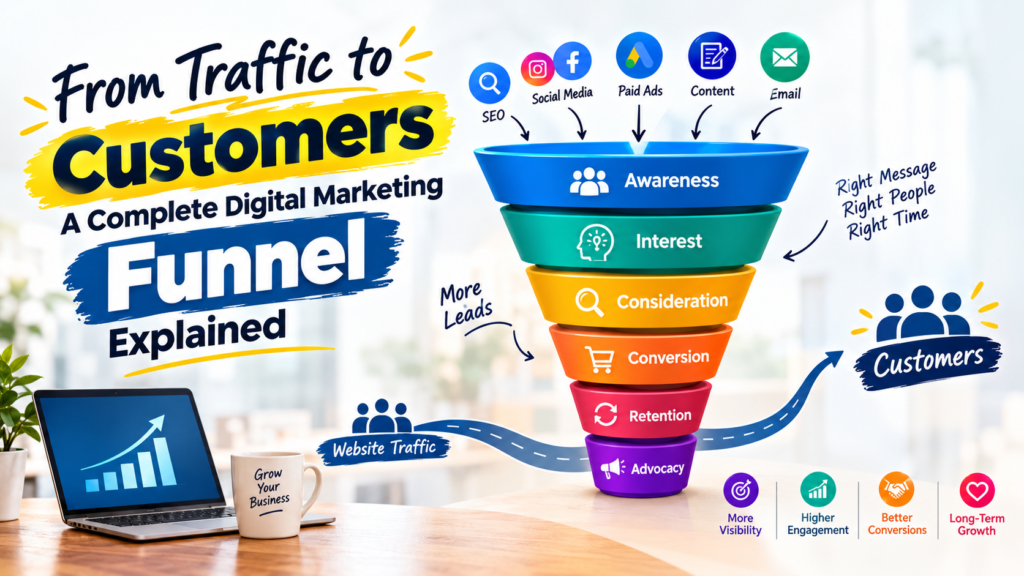
Getting website traffic is one of the first goals of digital marketing, but traffic alone does not generate revenue. A business can attract thousands of visitors and still struggle to generate leads or sales if there is no clear process for converting those visitors into customers.
This is where a Marketing Funnel becomes important.
A well-designed funnel helps businesses understand how people discover a brand, become interested in its products or services, evaluate their options, make a purchase, and eventually become repeat customers.
Instead of treating every visitor the same, a Marketing Funnel allows businesses to create different strategies for people at different stages of the customer journey.
For example, someone discovering your brand for the first time may need educational content, while someone who has already visited your pricing page may need a testimonial, comparison, or special offer before making a decision.
Understanding this journey can help businesses create better content, more relevant advertising campaigns, stronger landing pages, and more effective follow-up strategies.
In this complete guide, we will explain how a Marketing Funnel works, its different stages, the role of SEO, social media, paid advertising, email marketing, content marketing, retargeting, conversion optimization, and how businesses can build a practical funnel that turns traffic into customers.
What Is a Marketing Funnel?
A Marketing Funnel is a framework that represents the journey a potential customer takes from discovering a business to becoming a customer and, ideally, a loyal advocate.
The funnel is commonly divided into several stages:
Awareness → Interest → Consideration → Conversion → Retention → Advocacy
At the top, businesses attract people who may not know about the brand.
In the middle, those visitors begin researching and evaluating the available options.
At the bottom, qualified prospects take an action such as purchasing a product, booking a service, requesting a quotation, or signing up for a subscription.
After conversion, the relationship should continue through customer service, retention campaigns, loyalty programs, and personalized communication.
A Marketing Funnel therefore goes beyond simply generating website traffic. Its purpose is to move people from awareness toward meaningful business outcomes.
Why Is a Marketing Funnel Important?
Many businesses focus heavily on traffic, impressions, followers, and clicks. These metrics can be useful, but they do not automatically translate into revenue.
A Marketing Funnel helps connect marketing activities with the customer journey.
Suppose an online store receives 20,000 monthly visitors but only generates a small number of purchases. The problem may not be traffic. It could be weak product pages, unclear offers, lack of trust signals, poor follow-up, complicated checkout processes, or visitors arriving with low purchase intent.
A funnel allows marketers to identify these gaps.
For example:
- Traffic is low → improve SEO, content, and advertising.
- Engagement is low → improve messaging and creative.
- Product interest is low → improve positioning and offers.
- Conversion is low → optimize landing pages and checkout.
- Repeat purchases are low → improve retention and customer communication.
This makes a Marketing Funnel useful for both marketing strategy and business analysis.
The Main Stages of a Marketing Funnel
Stage 1: Awareness
The awareness stage is the top of the funnel.
At this stage, people may not know your business exists. They may be searching for information, researching a problem, watching videos, scrolling social media, or discovering brands through recommendations.
The objective is to attract attention without immediately forcing a sale.
SEO, social media, educational videos, blogs, podcasts, influencer marketing, digital advertising, and other discovery channels can support awareness.
A strong Marketing Funnel starts by understanding what the target audience is searching for and what problems they want to solve.
For example, a person searching for “how to improve Instagram engagement” may not yet be looking for a marketing agency. An agency can attract that person through useful educational content and gradually introduce its services.
Content for Awareness

Useful awareness-stage content includes:
- Blog articles
- Educational videos
- Social media posts
- Infographics
- Industry reports
- Beginner guides
- Podcasts
- Short-form videos
- Search-optimized informational pages
The goal is to provide value and create initial brand awareness.
Stage 2: Interest
Once someone discovers your business, the next challenge is keeping their attention.
This is the interest stage.
The visitor may read multiple articles, follow your social media profile, watch videos, explore your website, or subscribe to your email list.
At this stage, businesses need to demonstrate expertise and relevance.
A Marketing Funnel should provide content that answers the audience’s questions and helps them understand the problem more clearly.
For example, a web development company can publish content about website speed, mobile optimization, SEO, landing pages, and conversion optimization.
This content gives potential customers reasons to continue exploring the business.
Stage 3: Consideration
At the consideration stage, potential customers are actively evaluating solutions.
They may compare different businesses, check pricing, read reviews, explore case studies, and research product features.
This is where trust becomes extremely important.
A strong Marketing Funnel should provide evidence that helps customers make informed decisions.
Useful consideration-stage assets include:
- Case studies
- Customer testimonials
- Product comparisons
- Demonstrations
- Detailed service pages
- FAQs
- Pricing information
- Webinars
- Free consultations
- Product guides
Businesses should answer the questions that could prevent someone from purchasing.
Stage 4: Conversion
The conversion stage is where a prospect takes the desired action.
Depending on the business, that action could be:
- Purchasing a product
- Booking an appointment
- Requesting a quote
- Filling out a lead form
- Calling the business
- Starting a free trial
- Subscribing to a service
A Marketing Funnel should make this stage as simple as possible.
A confusing website, lengthy form, unclear pricing, weak call-to-action, or lack of trust can cause potential customers to leave.
Strong conversion pages usually include:
- Clear headlines
- Strong value proposition
- Relevant benefits
- Social proof
- Simple navigation
- Strong calls to action
- Trust signals
- Easy contact options
The fewer unnecessary obstacles a customer encounters, the easier it becomes for them to take action.
The Role of SEO in a Marketing Funnel
SEO can contribute to multiple stages of a Marketing Funnel.
At the awareness stage, informational keywords can attract people who are researching problems.
At the consideration stage, commercial keywords can attract people comparing solutions.
At the conversion stage, transactional keywords can attract users who are ready to purchase.
For example:
Informational:
“What is performance marketing?”
Commercial:
“Best performance marketing agency”
Transactional:
“Performance marketing services”
A strong SEO strategy creates content for different search intents rather than targeting only high-volume keywords.
Internal linking can then connect these pages and guide visitors toward relevant commercial or conversion-focused content.
The Role of Content Marketing
Content is one of the main engines of a Marketing Funnel.
Different types of content serve different stages.
Top-of-Funnel Content
- Educational blogs
- Beginner guides
- Social posts
- Videos
- Infographics
Middle-of-Funnel Content
- Case studies
- Comparison articles
- Webinars
- Detailed guides
- Expert insights
Bottom-of-Funnel Content
- Product pages
- Service pages
- Pricing pages
- Demonstrations
- Testimonials
- Consultation pages
The goal is not to publish content simply for the sake of publishing.
Every piece should have a purpose within the customer journey.
Social Media and the Marketing Funnel
Social media can influence almost every stage of a Marketing Funnel.
At the awareness stage, businesses can use reels, short videos, educational posts, collaborations, and advertisements to reach new audiences.
At the interest stage, businesses can use stories, carousels, tutorials, live sessions, and educational content to deepen engagement.
At the consideration stage, testimonials, case studies, product demonstrations, FAQs, and reviews can help build confidence.
At the conversion stage, businesses can use strong calls to action, promotional campaigns, lead forms, direct messages, and website links.
Social media therefore becomes much more powerful when it is connected to a broader customer journey.
Paid Advertising and the Funnel
Paid advertising can accelerate traffic and customer acquisition.
Platforms such as Google Ads and Meta Ads allow businesses to reach specific audiences and objectives.
A Marketing Funnel can help determine what type of advertisement should be shown at different stages.
For example, cold audiences may respond better to educational or problem-focused content.
Warm audiences who have already visited the website may respond better to testimonials, product benefits, or case studies.
Hot audiences may respond to direct offers, pricing, limited promotions, or consultation opportunities.
This approach can make advertising more relevant and reduce the risk of showing the same message to everyone.
Email Marketing in a Marketing Funnel
Email marketing is especially useful for leads who are interested but not ready to buy immediately.
A Marketing Funnel can use email sequences to educate leads, provide useful resources, answer objections, share case studies, and eventually introduce relevant offers.
A basic sequence could look like this:
Email 1: Welcome and introduction
Email 2: Educational content
Email 3: Common problem and solution
Email 4: Case study or testimonial
Email 5: Product or service explanation
Email 6: Offer or consultation
The sequence should provide value rather than sending aggressive sales messages.
Landing Pages and Conversion
Landing pages are critical because they are often where traffic becomes a lead or customer.
A Marketing Funnel can send different audiences to different landing pages based on their interests or intent.
For example, a paid advertisement about SEO should ideally lead to an SEO-focused page rather than a generic homepage.
A high-converting landing page usually contains:
- A clear headline
- A strong value proposition
- Relevant benefits
- Supporting visuals
- Social proof
- Objection handling
- A clear call to action
- Simple contact or purchase process
Message consistency between the advertisement and landing page is particularly important.
Retargeting and Funnel Recovery
Not every visitor converts during their first session.
Retargeting allows businesses to reconnect with previous visitors through appropriate advertising channels and privacy-compliant practices.
This can be especially valuable for products or services with longer decision-making cycles.
For example, someone may visit a service page but leave without contacting the business. A later campaign could remind them about the service, share a customer success story, or provide additional educational content.
Retargeting gives a Marketing Funnel another opportunity to bring interested prospects back into the customer journey.
Customer Retention
The funnel should not end after the first purchase.
Retention is one of the most valuable stages because existing customers have already experienced the business.
A strong Marketing Funnel can continue after conversion through:
- Email marketing
- Loyalty programs
- Personalized recommendations
- Customer support
- Educational content
- Exclusive offers
- Referral programs
- Feedback campaigns
The goal is to turn one-time customers into repeat customers.
Turning Customers Into Brand Advocates

Satisfied customers can become powerful sources of new business.
Reviews, referrals, testimonials, social sharing, and word-of-mouth recommendations can introduce a brand to new audiences.
A mature Marketing Funnel therefore includes advocacy.
Businesses can encourage advocacy by delivering excellent products, providing strong customer support, asking for genuine reviews, creating referral programs, and making it easy for customers to share their experiences.
How to Build a Marketing Funnel From Scratch
Building a Marketing Funnel does not have to be complicated.
Follow these steps.
Step 1: Define Your Target Customer
Understand who you want to attract.
Identify their:
- Problems
- Goals
- Interests
- Buying behavior
- Objections
- Preferred platforms
- Search behavior
Step 2: Define Your Conversion Goal
Decide what action you want visitors to take.
For example:
- Purchase
- Booking
- Lead form
- Phone call
- Free consultation
- Subscription
Step 3: Map the Customer Journey
Identify how customers discover your business, evaluate it, and eventually convert.
Step 4: Create Content for Each Stage
Develop awareness, consideration, and conversion content.
Step 5: Build Landing Pages
Create focused pages that match the intent of your campaigns.
Step 6: Add Follow-Up
Use email, retargeting, or other appropriate communication channels to stay connected with prospects.
Step 7: Track Performance
Measure traffic, engagement, leads, conversions, acquisition costs, and retention.
Step 8: Optimize
Identify where prospects are leaving and improve that stage.
Common Marketing Funnel Mistakes
Many businesses create funnels but fail to optimize them.
One common mistake is focusing only on traffic.
Another is sending every visitor to the homepage.
Some businesses also use the same message for every audience stage.
Other problems include:
- Weak calls to action
- Slow landing pages
- Poor mobile experience
- Complicated forms
- Lack of trust signals
- No follow-up system
- Poor analytics
- Irrelevant content
- No retargeting strategy
Avoiding these issues can make a Marketing Funnel much more effective.
Marketing Funnel Metrics to Track
A funnel should be measurable.
Important metrics include:
Awareness Metrics
- Impressions
- Reach
- Website traffic
- Organic visibility
- Video views
Engagement Metrics
- Time on page
- Engagement rate
- Pages per session
- Email engagement
- Content interactions
Conversion Metrics
- Conversion rate
- Leads
- Sales
- Cost per lead
- Customer acquisition cost
Retention Metrics
- Repeat purchase rate
- Customer lifetime value
- Churn rate
- Referral rate
Tracking the right metrics helps businesses understand where their Marketing Funnel is performing well and where improvements are needed.
Marketing Funnel for Small Businesses
Small businesses can benefit significantly from a simple funnel.
A basic setup could include:
SEO + Social Media → Website → Lead Magnet → Email Follow-Up → Consultation → Customer
For an ecommerce business:
Social Media/SEO → Product Page → Cart → Checkout → Purchase → Email Retention
For a local service business:
Google Search → Service Page → Contact Form → Consultation → Customer
The key is to create a journey that matches the business model.
A simple, well-optimized Marketing Funnel can often be more useful than a complicated system with too many disconnected tools.
The Future of Marketing Funnels
Customer journeys are becoming increasingly complex.
People may discover a business through social media, search for reviews on Google, watch a YouTube video, visit the website, compare competitors, receive a retargeting advertisement, and finally make a purchase through another device.
This means modern funnels are becoming less linear.
Artificial intelligence, automation, personalization, predictive analytics, conversational tools, and customer data platforms are making it possible to create more responsive experiences.
Future marketing systems will likely focus less on a simple linear funnel and more on connected customer journeys.
However, the fundamental principle will remain the same: understand what customers need at each stage and provide the right information or experience at the right time.
Final Thoughts
A Marketing Funnel is more than a diagram showing awareness, consideration, and conversion.
It is a practical framework for understanding how people move from discovering a business to becoming customers and eventually loyal advocates.
The most effective funnels connect multiple marketing channels.
SEO brings relevant traffic.
Content builds awareness and authority.
Social media creates engagement.
Paid advertising expands reach.
Landing pages generate conversions.
Email marketing nurtures prospects.
Retargeting brings interested visitors back.
Customer service strengthens relationships.
Analytics shows where improvements are needed.
When these elements work together, businesses can create a more predictable customer acquisition system.
The goal should not simply be to generate more traffic. The goal should be to generate the right traffic, provide valuable experiences, build trust, remove conversion barriers, and maintain relationships after the sale.
A well-planned Marketing Funnel allows businesses to stop treating every visitor the same and instead create experiences based on customer intent and behavior.
Whether you are running an ecommerce store, local business, service company, startup, personal brand, or digital marketing agency, understanding the customer journey can improve the way you attract and convert potential customers.
Ultimately, successful digital marketing is not just about being visible. It is about turning visibility into attention, attention into interest, interest into action, and customers into long-term relationships.
That is the real purpose of a Marketing Funnel.